


Mostrando postagens com marcador Political Analysis. Mostrar todas as postagens
Mostrando postagens com marcador Political Analysis. Mostrar todas as postagens
21 janeiro, 2019
 |
| Photo: Adriano Machado - Reuters |
The Brazilian President Jair Bolsonaro will outline his
government’s economic reform agenda and plans to increase trade with the rest
of the world during his speech at the World Economic Forum’s Annual Meeting in
Davos today.
Bolsonaro, a far-right former Army captain who took
office on Jan. 1st vowing to end years of graft and crack down on violent
criminals, will also pledge to lower rampant bureaucracy in Brazil, which many
view as a drag on the country’s stuttering economy.
Bolsonaro’s 40-minute speech is scheduled for Wednesday,
and he will also highlight efforts to simplify the economy, while pledging to
give legal certainty to investors and defend the rule of law.
Bolsonaro is also expected to comment on the situation in
neighboring Venezuela, which is undergoing an unprecedented crisis and growing
international pressure against the regime of President Nicolás Maduro.
A long-standing critic of Maduro, Bolsonaro has ruled out
military action to overthrow the current government, but said last week that a
solution for Venezuela will come “briefly,” without giving details of how that
would happen.
On his return from Davos, Bolsonaro will settle on a
model for its pension reform proposal, his chief of staff, Onyx Lorenzoni, said
on Tuesday.
Sources: Agência Brasil, Reuters
13 julho, 2018
 |
| Photo: France Presse Agency |
The Overview
Last 6th July, US
President Donald Trump announced tariffs of US$ 34 billion on Chinese imports.
It was the harshest measure in a global trade dispute between big nations
recorded in recent years. On that occasion, China said it would be forced to
retaliate imposing higher levies on goods that would ranging from
American soybeans to pork. And the promise was fulfilled.
“The United States has
violated World Trade Organization rules and ignited the largest trade war in
Economic History,” China's Commerce Ministry said in a statement. “Such tariffs
are typical trade bullying, and this action threatens global supply chains and
value chains, stalls the global economic recovery, triggers global market
turmoil, and will hurt more innocent multinational companies, enterprises and
consumers”, said that Chinese official.
Thus, over the past
week, US tariffs on $34 billion in Chinese products effectively went into
effect. China responded by slapping 25% duties on the same amount in US goods.
The trade war between the two nations had begun. As a new response, Trump's
administration released last Tuesday its list of $200 billion worth of Chinese
goods that it said it aims to subject to 10% tariffs following a review
process. In counterpart, China threatened retaliatory action and pledged that
it would lodge a complaint with the World Trade Organization.
The riskiest economic
gamble of Trump's Presidency could spread as it enters a new phase by imposing
direct costs on companies and consumers globally.
Beijing noticed that
the US side had threatened to impose additional tariffs forward gradually
should China take retaliatory measures. However, Chinese authorities want to
demonstrate that this logic of trade intimidation will not make them flinch. For
this purpose, in a tactical logic of time, China will have no choice but to
consolidate other markets for its products and expand relations to alternative
input providers during the “conflict”.
The Quorum’s View: during the conflict – and only during that time -,
opportunities for the Brazilian Agribusiness Sector
In the Agricultural Raw Materials sector - if Beijing really wants to demonstrate its
resistance to the trade war from Washington -, China will have to increase
soybean imports from other countries to reduce reliance on buying from the
United States.
Soybeans, crushed to
make cooking oil and the protein-rich animal feed ingredient soymeal, were the
biggest US agriculture export to China last year at a value of US$ 12,3
billion, according to the US Department of Agriculture (USDA). China, which
imports 60% of the soybeans traded worldwide, bought 32,9 million tons from the
United States in 2017, accounting for 34% of the total purchases.
For this reason, showing
concern on the trade war with the United States, the President of Chinese State
Grains Trader (COFCO) Yu Xubo already said in an interview with the Communist Party’s
official People’s Daily Paper last Wednesday that hefty import tariffs applied
by Beijing on American goods, including soybeans, will inflate costs for Chinese
farmers and potentially increase internal retail prices of foods, like pork,
the nation’s favorite meat.
Thus, China could
increase soybean imports from South American countries amid an escalating trade
dispute with the United States. Beijing can also buy more rapeseed, sunflower
seeds, and bring in more soybean meal, rapeseed meal, sunflower meal and
fishmeal to fill any supply gaps. Increasing meat imports would be also an
option.
In this regard, the
trade conflict between Beijing and Washington is already boosting grain and
oilseed exports from the Black Sea region, where major sellers including
Russia, Ukraine and Kazakhstan are looking to sell more corn, wheat and soybean
to the huge Chinese market. However, the isolated capacity of global offer of
these regions is limited. For example, a Rabobank report said last week it
reckoned China will have to buy 15 million tons of US beans with the new tariff
this year because there aren’t enough alternative sources of beans from other
major exporters.
That’s why Brazil could
indirectly benefit from the intensifying US-China trade war. The South American
country finds itself in a strategic position to increase its market share of
soybean exports to China. The other major producer, Argentina, is not in much
of a position to offer competition this year. Soybean production there has been
hammered by poor weather conditions that mean its crop is expected to be the
lowest in a decade.
This leaves the field
open to Brazil as the main supplier of soybeans and at more competitive prices
than the other options available on the market. Meanwhile, the weakness of the
Brazilian currency enhances farmers’ margins when compared with the more
expensive US grains that, despite the drop in prices caused by the US-China
trade dispute, are still not as attractive.
However, there are
doubts over how quickly Brazil will be able to react to the new trading situation
in the aftermath of a Truckers Strike protesting high fuel costs that halted
transport of cargoes to ports for more than two weeks. In fact, regular
loadings of cargoes at most ports weren’t impacted in the short term as the
grains being sold were old crops stored in silos located near the port
facilities. But it’s also true that Brazil still has structural problems in the
logistics field and its freight costs are higher than the US and more sensitive
to price shocks derived from increased demand.
All this involved, its
possible to affirm that Brazil will have comparative advantages in its capacity to offer agricultural raw materials to China in
this trade war environment against US. However - sooner or later -, once
re-established the regular trade relations between Washington and Beijing, Brazil will
lose these advantages and should be ready to readjust its volume of offers on
the raw materials global markets. The evaluation of the correct moment to
initiate this readjustment will depend on help of a good staff of analysts with
focus on the changes of geopolitical scenarios to the global
commodities sector.
Quorum Political Strategy is a government relations and political risk consulting
firm made up of experienced professionals who can help your organization
achieve its goals. We are a result-oriented consulting firm. Do not hesitate to
contact us.
25 maio, 2018
 |
| Photo: Everaldo Silva/Futura Press/Folhapress |
Brazil's Government said late Thursday that a deal had
been reached with truckers to suspend a four-day-old strike that caused fuel
shortages, cut into food deliveries, backed up exports and threatened airline
flights.
Eliseu Padilha, Chief of Staff for President Michel
Temer, told reporters in Brasília that several unions that represent truckers
agreed to suspend the strike for 15 days to give all parties time to negotiate
a solution to rising fuel prices that drivers say has cut deeply into their
earnings. The deal came after a full day of negotiations with several of the
largest transportation unions. But it wasn't immediately clear how many of the
thousands of truckers, who by the nature of their jobs operate with a good bit
of independence, would heed calls to stop the strike.
Brazil's economy runs largely on road transport and the
strike to protest rising diesel prices was beginning to have serious
consequences, with highway police reporting blocked roads in nearly all of
Brazil's states.
The airport in the Capital of Brasilia allowed landings
only by planes that carried enough fuel to take off again. The stop-gap measure
hadn't resulted in any flight cancelations, but it was unclear how long it
could continue before companies would have to ground planes. The civil aviation
authority and airport authorities said they were monitoring fuel supplies
carefully.
Long lines formed at gas stations, and some ran out of
some kinds of fuel. In Rio de Janeiro, only about two-thirds of the city's
buses were running Thursday, according to Rio Onibus, which represents the
companies that run the various lines.
Local media reported food shortages and rationing in some
supermarkets, and an association of supermarkets in Brazil's south warned that
perishable food would run out in days if the strike did not end. The
association said stores on average have a 15-day supply of dry goods, but fresh
food would run out or spoil before then.
The Brazilian Association of Meat Industry Exporters said
dozens of meatpacking plants were idling because of the strike, and 1,200
containers carrying beef for export were not being loaded on ships each day.
Brazil is one of the largest exporters of meat in the world.
Truckers complain that rising diesel prices have cut
deeply into their income and are demanding relief from the government. Diesel
prices are being pushed up by rising world oil prices and Brazil's falling real
currency.
On Wednesday night, the Lower House of Congress rushed
through a bill to eliminate a tax on diesel through the end of the year. But
the Senate still had to approve it.
Truckers rejected the Wednesday decision by the state oil
company Petrobras to reduce diesel prices at refineries by 10 percent. The
company said the measure would last for 15 days and give the Government time to
negotiate an end to the strike.
“The government thinks truckers are illiterate and can't
count,” said Vicente Reis, who has been driving for 20 years. ”In 2018, there
has already been about a 25% increase in fuel prices. And now they want a 15-day
freeze with (a reduction of) 10%. Truckers know how to count, Mr. President”.
Despite of Government announces about an alleged truce, Federal
Highway Patrol authorities informed this Friday morning that the roads are
still blocked throughout the country. Meanwhile, Brazilian Federal Police
investigates whether the truckers strike is, in reality, a lockout orchestrated
by businessmen from the logistics sector. Unofficially, Federal Government
considers to use Armed Forces troops to liberate the highways.
Sources: Agência Brasil, Mercopress Agency
14 abril, 2018
 |
| (Ford Williams/U.S. Navy) |
The United States, in a coordinated action with its
European allies (France and United Kingdom), launched strikes on Friday against
Syrian research, storage and military targets as President Trump sought to
punish President Bashar al-Assad for a suspected chemical attack near Damascus
last weekend that killed more than 40 people.
Britain and France joined the United States in the
strikes in a coordinated operation that was intended to show Western resolve in
the face of what the leaders of the three nations called persistent violations
of international law. Mr. Trump characterized it as the beginning of a
sustained effort to force Mr. Assad to stop using banned weapons.
The strikes, carried with ship-based cruise missiles and
manned aircraft, targeted three facilities associated with Syria’s chemical
weapons arsenal, including a scientific research facility around Damascus, a
chemical weapons storage facility around Homs alleged to be used for sarin gas
and a nearby command post, the Pentagon said.
The Syrian Observatory said the Syrian Army’s 4th
Division and Republican Guard was among the targets. Residents of Damascus, the
capital, woke to the sounds of multiple explosions shaking the city before the
dawn call to prayer. The city and the hills are surrounded by military
facilities, and it appeared that these were among the first targets.
Syrian State television said government air defense
systems were responding to “the American aggression” and aired video of
missiles being fired into a dark night sky. It was not clear if they hit
anything. It reported that 13 missiles had been shot down by Syrian air
defenses near Al-Kiswa, a town south of Damascus.
The targets were chosen to minimize the risk of
accidentally hitting Russian troops stationed in Syria, according to Gen. James
F. Dunford Jr., the chairman of the Joint Chiefs of Staff.
Defense Secretary Jim Mattis told reporters at the
Pentagon on Friday night that the strike was completed and was designed as a
one-night operation. “Right now this is a one-time shot and I believe it has
sent a very strong message to dissuade him to deter him from doing it again,”
he said.
Mr. Trump called on Syria’s patrons in Russia and Iran to
force Mr. Assad to halt the use of poison gas in the seven-year-old civil war
that has wracked his country.
“To Iran and to Russia I ask: What kind of a nation wants
to be associated with the mass murder of innocent men, women and children?” he
said. “The nations of the world can be judged by the friends they keep. No
nation can succeed in the long run by supporting rogue states, brutal tyrants
and murderous dictators.”
The strikes marked the second time that Mr. Trump has
attacked Syria to punish the government after it was accused of using chemical
weapons. The White House had sought to craft a response that would be more
robust than the attack in April 2017, when the United States fired 59 Tomahawk
cruise missiles at a Syrian air base that was back in use a day later.
27 novembro, 2017
 |
| Photo: Beto Barata/PR |
A new version of Brazil’s unpopular Pension Reform bill
presented last Wednesday will suggest “softer” rules for retirement and social
security contributions, according to a draft of the legislation that the Government
hopes will win approval in Congress.
The new bill will require a minimum of 15 years of
contributions from private sector workers, compared to 25 years in the previous
draft bill and 15 currently. Public servants would have a 25-year minimum, and
all workers would need to work 40 years to retire on full pension.
The
bill maintains the minimum retirement age of 65 years for men and 62 years for
women, a key proposal for reducing the cost of Brazil’s pension system.
Pension
reform is the cornerstone policy in President Michel Temer’s efforts to bring
the deficit under control, but he lacked the votes to get a tougher version
approved by lawmakers who worried the unpopular measures would hurt their
re-election chances next year.
Temer used political capital blocking corruption charges
that further undermined support for his policies and delayed a pension reform
vote in Congress by six months.
The
revamped bill maintains the same retirement rules for rural workers that are in
effect now, dropping proposals for tighter standards.
In
the current bill, rural workers will contribute for 15 years to get a pension,
10 years less than the Government’s initial proposal. The minimum retirement
age for female and male rural workers will be kept respectively at 55 and 60
years, the same as today, according to the draft.
The Government
restored a guarantee that disabled or elderly people unable to support
themselves would receive an additional amount so their total payment meets a
monthly minimum,
The
speaker of the Lower House of Congress, Rodrigo Maia, warned this week said
that the government did not have the 2/3 majority of votes needed to pass a Pension
Reform.
Maia
said the government should work to strengthen its base first, which Temer
sought to do on Wednesday by swearing in Alexandre Baldy to head the Ministry
of Cities, a move designed to please the Baldy’s Progressive Party (right
wing), which has 40 seats in the chamber.
Source:
Mercopress Agency
23 setembro, 2017
 |
| Photo: Marcelo Camargo - Agência Brasil |
Brazil’s Central Bank trimmed its inflation forecast on
Thursday and said it expected economic growth to pick up into next year,
painting an optimistic picture for Latin America’s largest economy as interest
rates approach record lows.
In a quarterly inflation report, the Central Bank
forecast economic growth of 0.75% in 2017, up from a previous estimate of 0.5%.
For 2018, the Bank forecast growth of 2.2%. Inflation is estimated at 3.2% in
2017 and 4.3% in 2018, down from 3.3% and 4.4% respectively that it expected
previously.
The Central Bank, which has slashed interest rates from
14.25% to 8.25% over the past year to revive a recession-hit economy,
maintained its forecast of gradually reducing the pace of interest rate cuts in
coming months.
The Bank extended its inflation scenario to include
forecasts for 2019 and 2020, at 4.2% and 4.1% respectively. With inflation
estimates hovering around the official target of 4% for 2020, policymakers said
monetary policy can continue to stimulate economic growth.
Economists expect the bank to cut its benchmark interest
Selic rate to 7.00 percent by December, below an all-time low of 7.25%t, and
keep the rate at that level through 2018, a weekly central bank survey showed
on Monday.
Brazil’s economy resumed growth in the first half of this
year after 3 years of its worst recession on record. While stronger consumption
has driven the gradual recovery for now, investments are expected to grow 3% in
2018 thanks to lower interest rates, the bank predicted.
Temer Presidency: deep disapproval among Brazilians
Nevertheless, approval for Brazilian President Michel
Temer's government has plummeted, according to a poll published on Tuesday, as
the scandal-plagued leader faces new corruption charges and struggles to push
his economic reform agenda through Congress.
Polling firm MDA said that only 3.4% of those surveyed
thought the Temer government was doing a “great or good” job - down from 10.3%
in MDA's last such poll in February.
Temer took over a year ago from impeached leftist Dilma
Rousseff and has said he does not care about popularity and only wants to push
through an austerity package before his term ends in Jan. 2019. Yet his ability
to do so has been hamstrung by charges of taking bribes, racketeering and
obstruction of justice.
The charges against Temer are based on the plea-bargain
testimony of the owners of the world's largest meatpacker, JBS SA. They
accuse Temer of taking bribes in return for political favors and of conspiring
to buy the silence of a witness who could implicate the leader. Temer has
repeatedly denied any wrongdoing.
The
MDA poll was commissioned by the national transport lobby CNT and surveyed
2,002 people across Brazil from Sept. 13-16. The poll has a margin of error of
2.2 percentage points.
Source:
Mercopress Agency
16 agosto, 2017
 |
| Photo: Ueslei Marcelino/Reuters |
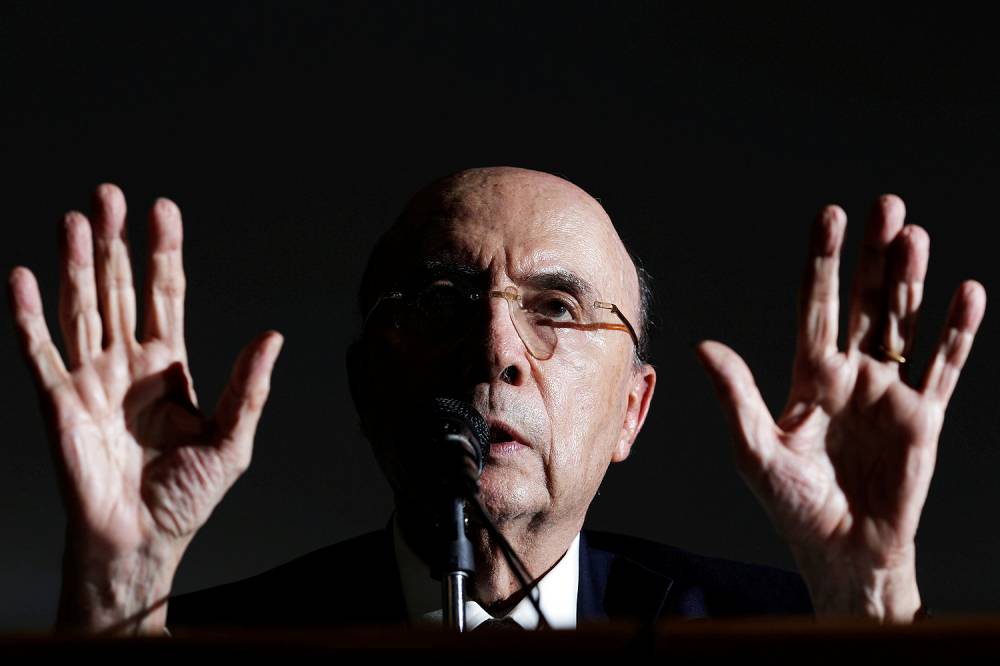
Brazil's government relaxed its budget targets until 2020 this Tuesday, delaying prospects for a drop in the federal deficit after legislators repeatedly refused to raise taxes in the recession-hit economy.
Cost-cutting measures were announced along with the new targets, in a bid to demonstrate President Michel Temer's commitment to fiscal discipline even after his economic team cut forecasts for economic growth next year.
The revision, announced weeks earlier than expected, underscored the uphill battle for Temer to gather support for austerity measures as a corruption scandal simmers and next year's general elections approach.
Market reaction was muted as investors did not expect a surge in government spending despite the new targets. Ratings agency Standard & Poor's spared Brazil from a downgrade, saying after the announcement that it would maintain the country's debt rating at BB with a negative outlook.
Brazil's government set a new primary deficit target for this year and next of R$ 159 billion ($49.7 billion), up from R$ 139 billion this year and R$ 129 billion for 2018.
The country will target a deficit of R$ 139 billion for 2019, up from R$ 65 billion previously. For 2020, it will aim for a R$ 65 billion deficit compared with a R$ 10 billion surplus previously - raising prospects of a seven-year-long period of consecutive budget deficits, started in 2014.
Members of Temer's economic team, including Finance Minister Henrique Meirelles, previously wanted to wait until September to consider a looser budget target, but agreed to move up talks under pressure from a fractious coalition in Congress.
Most cost-cutting measures announced by Meirelles and Planning Minister Dyogo Oliveira this Tuesday will need Congress' approval. They include postponing public sector salary hikes by one year and reducing the entry salary for incoming civil servants.
Despite strong opposition to tax hikes, Meirelles said the government would still seek to roll back payroll tax breaks and would raise taxes on some investment funds.
The government did not announce expected infrastructure concessions. It forecast 2% growth in 2018, down from a previous estimate of 2.5%.
Congress leader says Brazil Government doesn't have votes to pass social security reform
The Speaker of Brazil's Lower House said Tuesday the government doesn't have the votes to pass a social security overhaul that is key to President Michel Temer's economic agenda.
The comments by Chamber of Deputies Speaker Rodrigo Maia came after a meeting with Finance Minister Henrique Meirelles as well as the leaders of the parties in congress.
"It would have been ideal to approve the reform today," Maia said, arguing that it was the only straightforward solution to the country's economic crisis.
The government would need 308 votes to pass the constitutional amendment in the 513-member Lower House.
Temer, whose approval rating was 5% in the latest national poll, has been counting on his proposals for loosening work rules and changing pensions to revive the economy and help save his Presidency. Failure to pass them could undermine crucial support for him and could leave him vulnerable to a second round of corruption charges.
The pension overhaul is less appealing to congressmen looking ahead to the 2018 general elections.
The Chamber of Deputies recently voted against sending Temer to trial on a bribery charge. However, the mounting pressure on the President weakened his governing coalition in the lead-up to that vote and has put the brakes on his economic agenda.
Temer could also face new accusations in the near future.
The Chamber of Deputies recently voted against sending Temer to trial on a bribery charge. However, the mounting pressure on the President weakened his governing coalition in the lead-up to that vote and has put the brakes on his economic agenda.
Attorney General Rodrigo Janot, who filed the bribery charge against the President, said last week that plea bargains being negotiated could lead to new charges against Temer. Janot's term as Brazil's top lawman ends September 17th, meaning his time is running short to deliver on his warning.
Sources: Reuters, Agência Brasil
09 maio, 2017
The
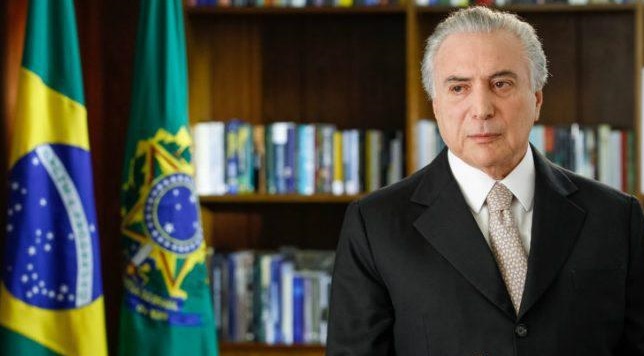
defense counsel of Brazil's President Michel Temer has sent its closing
arguments to the Superior Electoral Court (TSE) in connection with a lawsuit
challenging the victory of the 2014 presidential re-election ticket—in which
Temer was Dilma Rousseff's running mate—on charges of “abuse of political and
economic power.” His counsel has repeatedly said removing him from office would
have serious consequences for Brazil.
“The
current situation of the country is of particular concern [an issue posed for
the court's consideration as well], and would make a measure of this magnitude
unadvisable because of its short-term consequences for both political and
economic stability,” read the document signed by lawyers Gustavo Bonini Guedes,
Marcus Vinicius Furtado Coêlho, and Paulo Henrique dos Santos Lucon, who are defending Temer.
In
early April, Rousseff's lawyers and Temer's lawyers appealed to the court to
extend their deadline so they could present further closing arguments.
Motion to quash evidence
In
the new arguments, which are three pages longer than the original draft,
Temer's defense has moved for the court to quash the testimonies given by João
Santana and his wife Mônica Moura, the marketers behind Rousseff and Temer's
2014 campaign. Heard at the late evidentiary stage of the case, the couple gave
details of the payments for their advertising services through offshore
accounts.
Background
The
lawsuit was filed with the Superior Electoral Court by the PSDB —the party of
Rousseff's and Temer's main opponent in the 2014 election, Aécio Neves, which
became part of the governing coalition as Temer took over presidency with
Rousseff's impeachment in 2016. The party said the 2014 winning ticket had
potentially had its campaign funded with the proceeds of the Petrobras
corruption scandal revealed by the massive Car Wash probe. But the defense
maintained the facts that surfaced from the evidentiary stage of the election
lawsuit were unrelated to Petrobras, and as such, were beyond the scope of the
charges.
Moreover,
the lawyers pointed out, Rousseff and Temer's accounts should be examined
separately, because Temer had set up an individual bank account to manage
campaign funds. The defense argues Temer was elected vice-president, not “the
president's deputy”.
Source: Agência Brasil
26 abril, 2017

The European Union and Mercosur should intensify talks to
advance in theirs trade agreement this year, Spanish Prime Minister Mariano Rajoy
said on Tuesday (25/04), urging after 18 years of negotiations.
Rajoy’s comments at a trade event in the city of São
Paulo reinforced a 2017 target proposed on Monday (24/04) by the Argentinian
Foreign Minister Susana Malcorra and EU Ambassador to Brazil João Cravinho, who
said a deal could be ratified in 2018 and implemented in 2019.
Rajoy said an accord is “closer than ever” and
highlighted opportunities for Spanish investments in Brazilian infrastructure,
energy and transportation sectors. Spain has been the second-largest source of
foreign investment in Brazil after the United States.
Brazilian Foreign Minister Aloysio Nunes said that
Mercosur must focus on lowering its internal trade barriers to ease talks with
Brussels, questioning disparate price schemes for Brazilian and Argentinian
produce, for example.
Mercosur founding members, which also includes Uruguay
and Paraguay, began negotiations with the European Union in 1999, broke them
off in 2004 and resumed talks again in 2010.
Malcorra suggested on Monday that a United States retreat
from global trade talks had opened a window for the European Union to become a
strong player in multilateral accords between regions.
Sources: Agência Brasil, Mercopress Agency, Itamaraty
31 março, 2017

A Federal Court sentenced Brazil’s former speaker of the Lower House, Eduardo
Cunha, to more than 15 years in prison on Thursday for corruption, making him
the highest-profile political conviction yet in the “Operation Car Wash”
scandal. The former politician’s defense team said they would appeal the
decision but Cunha will remain imprisoned pending appeal.
Cunha,
who drove the successful impeachment of former President Dilma Rousseff, was
forced from his position as speaker in July and arrested in October on
accusations he received millions in bribes from the purchase of an oil field in
Benin by state-run oil company Petrobras.
Over
200 people have been charged in the “Operation Car Wash” probe, a far-reaching
investigation that centers on bribes and political kickbacks from contracts at
Petrobras. The Supreme Court is likely to approve soon the investigation of
dozens of sitting politicians.
In
February 2015, Cunha, a member of President Michel Temer’s Brazilian Democratic
Movement Party (PMDB) that for a decade was the main member of left-leaning
Workers Party (PT) governments, defied the wishes of his own coalition to run
for and win the speakership of the lower house of Congress.
Just
six months later, he officially broke with the PT government of Rousseff,
saying that she was using the Petrobras investigation as a tool of “political
persecution” against him.
As
speaker, only Cunha could allow impeachment proceedings to begin against
Rousseff, whom critics accused of breaking budgetary laws. He did just that in
December 2015, just hours after PT deputies cast deciding votes for him to face
an investigation by the House’s ethics committee for lying about bank accounts
he and his wife held in Switzerland.
By
May, Rousseff was impeached and Temer installed as successor. But Cunha could
not shake free of corruption allegations that eventually led to his downfall.
Once he was kicked out of congress, Cunha lost the privilege given to sitting
politicians that only the badly overburdened Supreme Court can try them.
His
case was instead sent to the federal judge Sergio Moro, who has been the driving
force behind Brazil’s fight against graft. Moro has a reputation for plowing
through cases efficiently, with over 98% of his convictions in Car Wash cases
being upheld by higher courts.
Cunha
faces another trial for allegedly receiving US$5 million skimmed from Petrobras
contracts for two drill ships in 2006 and 2007.
Source:
Mercopress Agency
11 março, 2017

Brazil's
official inflation, as measured by the National Broad Consumer Price Index
(IPCA) is expected to close out the year below the center of the target (4.5%).
The estimate was made by the Institute for Applied Economic Research (IPEA),
which released its report on the first quarter of 2017. The institute did not
announce a specific estimate for the IPCA, but merely declared it should end
the year below 4.5%.
After
last year's deflation, the institute reported, fixed prices (like energy,
transport and other public fees) are to face a slight hike this year. The
phenomenon is expected to raise inflation in the last quarter, but not enough
to exceed the center of the target.
Food
According
to IPEA, price rates are expected to slow further down for the rest of the
year, thanks to the behavior of free prices. Most noteworthy are food prices,
which should face a weaker increase this year, or even decline in some cases,
as a result of the increase in grain harvests and oil-producing plants and not
as a result of climate phenomena in the main producing regions, as has been the
case over the previous years.
As
for decisive external factors, IPEA reported that the price of commodities will
hold steady chiefly for three reasons. Oil extraction will be counterbalanced
by the increase in the US production of shale oil, the havests in both
hemispheres are expected to rise, and China's decision to curb economic growth
should pull down the globe's demand for iron ore.
Source:
Agência Brasil
20 fevereiro, 2017

In a response to Trump's trade policy, Mexican Agriculture Secretary said last Thursday he will lead a business delegation to Argentina and
Brazil to explore buying yellow corn, part of a drive to lessen Mexico's U.S.
dependence.
The trip will happen within the next 20 days,
Agriculture Secretary José Calzada said, adding that the government could
explore quotas and changing the tariff regime for imports from South America if
needed.
On
Sunday the Mexican senator Armando Rios Piter, who leads a congressional
committee on foreign relations, says he would introduce a bill this week, to
shift corn import demand to Brazil and Argentina instead of the United States.
“I'm
going to send a bill for the corn that we are buying in the Midwest
and...change to Brazil or Argentina,” Rios Piter told CNN.
On Wednesday Marisa Bircher, Argentina's Secretary of Agro-Industrial markets,
said that the country hopes to increase exports to Mexico. Argentina exported less than 100,000 tons of corn to
Mexico last year.
“Corn
is obviously a sector that is on the list to have greater access and gain a bit
more space for Argentina, regardless of the presence of the US market,” Ms. Bircher said.
Ms. Bircher said there was also potential for poultry and beef exports to Mexico.
Mexico last year imported 13 million tons of yellow corn,
of which 12.75 million tons were provided by US farmers with a bill of US$
2.3bn.
EFTA/Mercosur
talks: confirmed to begin next June
The first round of formal trade negotiations between
Mercosur and EFTA, European Free Trade Association, is scheduled to take place
in Buenos Aires next June according to information from Brussels where there
was a preliminary encounter between the two sides. “It will be in June, and
talks will be at chief negotiators level”, confirmed EFTA and Mercosur sources.
The Brussels
meeting was headed by Argentine ambassador Guillermo Daniel Raimondi, in
representation of Mercosur and Norway's Sveinung Roren for EFTA, which is made
up of Iceland, Liechtenstein, Norway and Switzerland, none of them EU members.
“It was also agreed a second meeting in August and the
necessary exchange of information, such as nomenclature, stats, trade
legislation and policies”, added Mercosur sources. Bilateral trade between the
two blocks reached 8.7bn in 2015 when the first contacts were started. Last
January in Davos Economic Forum the round of discussions was first agreed.
EFTA
exported mostly pharmaceutical products (US$ 1.4bn); organic chemicals (US$
764m), and machinery (US$ 462m), while Mercosur countries shipped US$ 1.9 bn in
precious stones and metals; US$ 859m in inorganic chemical products; US$ 357 in
food and US$ 259m in coffee, tea and species.
“We
are optimistic about this coming round, which is part of the opening of
Mercosur to the world”, said the South American source, which last week was
also involved in negotiations with the EU-28 ahead of the Buenos Aires round in
March.
“The
purpose of this trip and technical talks to Brussels was precisely to get ready
for Buenos Aires and concentrate in the chapters of government procurement,
market access, animal and plant sanitary measures plus services and
investments”, added the source.
European
Commission sources indicated that negotiations agreed “to intensify the
technical work” in anticipation of Buenos Aires but also working on a tentative
timetable of reaching an agreement at the end of the year. This last leg of EU/Mercosur negotiations took off in
2010, following several years of suspension.
Sources: Agência Brasil, Mercopress Agency
Assinar:
Postagens (Atom)
Postagens populares
-
 Câmara aprova MP que dispensa emplacamento de máquinas agrícolas Entre outros pontos, texto aprovado também aumenta as penalidades de trân...
 -
 O Plenário da Câmara dos Deputados poderá votar projetos sobre segurança pública a partir desta terça-feira (24). Há um total de 20 projet...
 -
 Hoje na Câmara dos Deputados: tramitação está na fase 13 Acompanhe ao vivo A comissão especial que analisa o projeto que estabe...
 -
 Os integrantes da CPI Mista da Petrobras vão decidir na quarta-feira (12), a partir das 10h15, a versão final do relatório da comissão sob...
 -
18/08/2015, 10h42 Sessão do Congresso do dia 11 de março, a última em que houve votação de vetos Geraldo Magela/Agê...


