


Mostrando postagens com marcador Brazilian Politics. Mostrar todas as postagens
Mostrando postagens com marcador Brazilian Politics. Mostrar todas as postagens
21 janeiro, 2019
 |
| Photo: Adriano Machado - Reuters |
The Brazilian President Jair Bolsonaro will outline his
government’s economic reform agenda and plans to increase trade with the rest
of the world during his speech at the World Economic Forum’s Annual Meeting in
Davos today.
Bolsonaro, a far-right former Army captain who took
office on Jan. 1st vowing to end years of graft and crack down on violent
criminals, will also pledge to lower rampant bureaucracy in Brazil, which many
view as a drag on the country’s stuttering economy.
Bolsonaro’s 40-minute speech is scheduled for Wednesday,
and he will also highlight efforts to simplify the economy, while pledging to
give legal certainty to investors and defend the rule of law.
Bolsonaro is also expected to comment on the situation in
neighboring Venezuela, which is undergoing an unprecedented crisis and growing
international pressure against the regime of President Nicolás Maduro.
A long-standing critic of Maduro, Bolsonaro has ruled out
military action to overthrow the current government, but said last week that a
solution for Venezuela will come “briefly,” without giving details of how that
would happen.
On his return from Davos, Bolsonaro will settle on a
model for its pension reform proposal, his chief of staff, Onyx Lorenzoni, said
on Tuesday.
Sources: Agência Brasil, Reuters
01 junho, 2018
 |
| Photo: Sergio Moraes/Reuters |
The Chief Executive of Brazil´s state-controlled oil
giant Petrobras, Pedro Parente, decided to step down from his post Friday (June
1). The decision was made public in an urgent announcement to the market.
Parente met with President Michel Temer at the Planalto presidential palace.
The statement released by Petrobras says that “the
appointment of an acting CEO will be considered by the firm’s managing board
later today. The remaining members of the company’s board of executives will
not undergo any changes.”
At 11:20 am, after Parente’s decision to resign was made
public, a plunge was observed at the São Paulo stock exchange. The firm also
reported that the trading of its PETR-N2 shares was suspended from 11:22 to
11:42 am, but was subsequently resumed.
Surprise
Petrobras Chief Executive quit this Friday is a surprise
move that wiped some $12 billion off the state-controlled oil producer’s market
valuation, after Brazil’s government responded to a trucking strike by
intervening in the company’s fuel pricing policy.
Pedro Parente, who in two years in the job had succeeded
in slashing Petrobras’ debt and restoring it to profitability, said in a
resignation letter to President Michel Temer it was clear after the last week’s
turmoil that new talks would be needed on pricing policy.
“Given this situation, it has become clear that my
remaining as CEO of Petrobras has stopped being positive and will not
contribute to the alternatives that the government must consider going forward,”
Parente said in the letter.
Shares in Petrobras, Latin America’s biggest oil
producer, plummeted as much as 15 percent in afternoon trading, wiping some 45
billion reais ($12 billion) from the company’s capitalization and pushing
Brazil’s wider Bovespa index into negative territory. The real currency
weakened as much as 1 percent against the dollar. Petrobras bonds also fell.
Still, his resignation appeared to have taken Temer’s
already beleaguered government by surprise. A senior presidential source told
on Thursday that no such move was expected.
Truckers’
Strike Impact
A key plank of Parente’s turnaround campaign for the
company and a condition for his taking the top job in 2016 was freedom to
control fuel prices. He sought to align those more closely with international
markets through nearly daily price adjustments.
But on Sunday Temer, governing with rock-bottom approval
ratings, announced plans to placate the striking truck drivers - who were
protesting the high cost of diesel - by freezing fuel prices on a monthly basis
and taking other measures to bring domestic diesel prices down.
Truckers have gradually returned to work since then,
after a protest that left gas stations and some airports without fuel and
supermarket shelves bare.
“The policy (Parente) put in place was the scapegoat of
this whole crisis,” said Roberto Castello Branco, a former Petrobras board
member, arguing that Temer’s weakened government must have asked Parente for
changes he could not accept. “The pressure on him was enormous.”
“Terrible
Administrator”
While investors and oil industry insiders bemoaned his
departure, others rejoiced.
“Parente was the most responsible for the crisis that
Brazil has faced with the trucker strike,” the truckers lobby said in a
statement. “Nothing justifies the abusive diesel prices put in place by the company
in the last few months.”
Petrobras oil workers, who walked off the job earlier
week in part to demand Parente’s dismissal, also celebrated.
“Pedro Parente, you will go down in history as a terrible
administrator, who took gasoline away from Brazilians,” Jose Maria Rangel,
leader of FUP, Brazil’s largest oil workers union, said in a video message.
“You don’t deserve to walk through the doors of Petrobras again.”
Parente’s departure comes days before Brazil hopes to
attract foreign oil companies to bid on oil fields in its coveted “presalt”
exploration areas and leaves in limbo several of his key priorities, including
selling major refineries.
Also unresolved is a long-running dispute with the
government over an oil-rich offshore area, which could represent a windfall for
Petrobras if a deal is reached.
Sources: Agência Brasil, Reuters
25 maio, 2018
 |
| Photo: Everaldo Silva/Futura Press/Folhapress |
Brazil's Government said late Thursday that a deal had
been reached with truckers to suspend a four-day-old strike that caused fuel
shortages, cut into food deliveries, backed up exports and threatened airline
flights.
Eliseu Padilha, Chief of Staff for President Michel
Temer, told reporters in Brasília that several unions that represent truckers
agreed to suspend the strike for 15 days to give all parties time to negotiate
a solution to rising fuel prices that drivers say has cut deeply into their
earnings. The deal came after a full day of negotiations with several of the
largest transportation unions. But it wasn't immediately clear how many of the
thousands of truckers, who by the nature of their jobs operate with a good bit
of independence, would heed calls to stop the strike.
Brazil's economy runs largely on road transport and the
strike to protest rising diesel prices was beginning to have serious
consequences, with highway police reporting blocked roads in nearly all of
Brazil's states.
The airport in the Capital of Brasilia allowed landings
only by planes that carried enough fuel to take off again. The stop-gap measure
hadn't resulted in any flight cancelations, but it was unclear how long it
could continue before companies would have to ground planes. The civil aviation
authority and airport authorities said they were monitoring fuel supplies
carefully.
Long lines formed at gas stations, and some ran out of
some kinds of fuel. In Rio de Janeiro, only about two-thirds of the city's
buses were running Thursday, according to Rio Onibus, which represents the
companies that run the various lines.
Local media reported food shortages and rationing in some
supermarkets, and an association of supermarkets in Brazil's south warned that
perishable food would run out in days if the strike did not end. The
association said stores on average have a 15-day supply of dry goods, but fresh
food would run out or spoil before then.
The Brazilian Association of Meat Industry Exporters said
dozens of meatpacking plants were idling because of the strike, and 1,200
containers carrying beef for export were not being loaded on ships each day.
Brazil is one of the largest exporters of meat in the world.
Truckers complain that rising diesel prices have cut
deeply into their income and are demanding relief from the government. Diesel
prices are being pushed up by rising world oil prices and Brazil's falling real
currency.
On Wednesday night, the Lower House of Congress rushed
through a bill to eliminate a tax on diesel through the end of the year. But
the Senate still had to approve it.
Truckers rejected the Wednesday decision by the state oil
company Petrobras to reduce diesel prices at refineries by 10 percent. The
company said the measure would last for 15 days and give the Government time to
negotiate an end to the strike.
“The government thinks truckers are illiterate and can't
count,” said Vicente Reis, who has been driving for 20 years. ”In 2018, there
has already been about a 25% increase in fuel prices. And now they want a 15-day
freeze with (a reduction of) 10%. Truckers know how to count, Mr. President”.
Despite of Government announces about an alleged truce, Federal
Highway Patrol authorities informed this Friday morning that the roads are
still blocked throughout the country. Meanwhile, Brazilian Federal Police
investigates whether the truckers strike is, in reality, a lockout orchestrated
by businessmen from the logistics sector. Unofficially, Federal Government
considers to use Armed Forces troops to liberate the highways.
Sources: Agência Brasil, Mercopress Agency
27 novembro, 2017
 |
| Photo: Beto Barata/PR |
A new version of Brazil’s unpopular Pension Reform bill
presented last Wednesday will suggest “softer” rules for retirement and social
security contributions, according to a draft of the legislation that the Government
hopes will win approval in Congress.
The new bill will require a minimum of 15 years of
contributions from private sector workers, compared to 25 years in the previous
draft bill and 15 currently. Public servants would have a 25-year minimum, and
all workers would need to work 40 years to retire on full pension.
The
bill maintains the minimum retirement age of 65 years for men and 62 years for
women, a key proposal for reducing the cost of Brazil’s pension system.
Pension
reform is the cornerstone policy in President Michel Temer’s efforts to bring
the deficit under control, but he lacked the votes to get a tougher version
approved by lawmakers who worried the unpopular measures would hurt their
re-election chances next year.
Temer used political capital blocking corruption charges
that further undermined support for his policies and delayed a pension reform
vote in Congress by six months.
The
revamped bill maintains the same retirement rules for rural workers that are in
effect now, dropping proposals for tighter standards.
In
the current bill, rural workers will contribute for 15 years to get a pension,
10 years less than the Government’s initial proposal. The minimum retirement
age for female and male rural workers will be kept respectively at 55 and 60
years, the same as today, according to the draft.
The Government
restored a guarantee that disabled or elderly people unable to support
themselves would receive an additional amount so their total payment meets a
monthly minimum,
The
speaker of the Lower House of Congress, Rodrigo Maia, warned this week said
that the government did not have the 2/3 majority of votes needed to pass a Pension
Reform.
Maia
said the government should work to strengthen its base first, which Temer
sought to do on Wednesday by swearing in Alexandre Baldy to head the Ministry
of Cities, a move designed to please the Baldy’s Progressive Party (right
wing), which has 40 seats in the chamber.
Source:
Mercopress Agency
23 setembro, 2017
 |
| Photo: Marcelo Camargo - Agência Brasil |
Brazil’s Central Bank trimmed its inflation forecast on
Thursday and said it expected economic growth to pick up into next year,
painting an optimistic picture for Latin America’s largest economy as interest
rates approach record lows.
In a quarterly inflation report, the Central Bank
forecast economic growth of 0.75% in 2017, up from a previous estimate of 0.5%.
For 2018, the Bank forecast growth of 2.2%. Inflation is estimated at 3.2% in
2017 and 4.3% in 2018, down from 3.3% and 4.4% respectively that it expected
previously.
The Central Bank, which has slashed interest rates from
14.25% to 8.25% over the past year to revive a recession-hit economy,
maintained its forecast of gradually reducing the pace of interest rate cuts in
coming months.
The Bank extended its inflation scenario to include
forecasts for 2019 and 2020, at 4.2% and 4.1% respectively. With inflation
estimates hovering around the official target of 4% for 2020, policymakers said
monetary policy can continue to stimulate economic growth.
Economists expect the bank to cut its benchmark interest
Selic rate to 7.00 percent by December, below an all-time low of 7.25%t, and
keep the rate at that level through 2018, a weekly central bank survey showed
on Monday.
Brazil’s economy resumed growth in the first half of this
year after 3 years of its worst recession on record. While stronger consumption
has driven the gradual recovery for now, investments are expected to grow 3% in
2018 thanks to lower interest rates, the bank predicted.
Temer Presidency: deep disapproval among Brazilians
Nevertheless, approval for Brazilian President Michel
Temer's government has plummeted, according to a poll published on Tuesday, as
the scandal-plagued leader faces new corruption charges and struggles to push
his economic reform agenda through Congress.
Polling firm MDA said that only 3.4% of those surveyed
thought the Temer government was doing a “great or good” job - down from 10.3%
in MDA's last such poll in February.
Temer took over a year ago from impeached leftist Dilma
Rousseff and has said he does not care about popularity and only wants to push
through an austerity package before his term ends in Jan. 2019. Yet his ability
to do so has been hamstrung by charges of taking bribes, racketeering and
obstruction of justice.
The charges against Temer are based on the plea-bargain
testimony of the owners of the world's largest meatpacker, JBS SA. They
accuse Temer of taking bribes in return for political favors and of conspiring
to buy the silence of a witness who could implicate the leader. Temer has
repeatedly denied any wrongdoing.
The
MDA poll was commissioned by the national transport lobby CNT and surveyed
2,002 people across Brazil from Sept. 13-16. The poll has a margin of error of
2.2 percentage points.
Source:
Mercopress Agency
16 agosto, 2017
 |
| Photo: Ueslei Marcelino/Reuters |
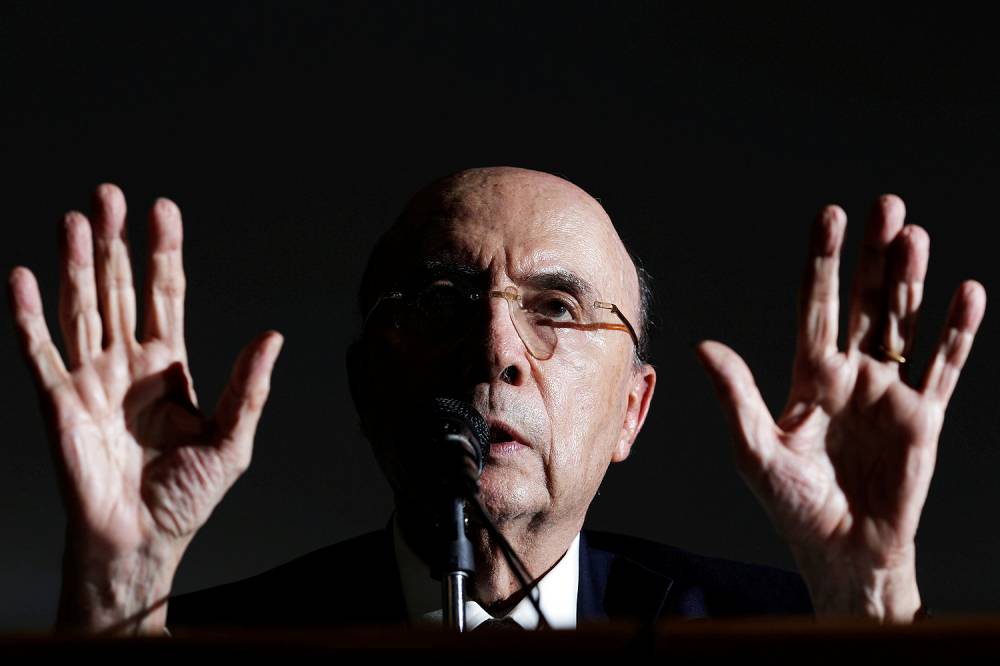
Brazil's government relaxed its budget targets until 2020 this Tuesday, delaying prospects for a drop in the federal deficit after legislators repeatedly refused to raise taxes in the recession-hit economy.
Cost-cutting measures were announced along with the new targets, in a bid to demonstrate President Michel Temer's commitment to fiscal discipline even after his economic team cut forecasts for economic growth next year.
The revision, announced weeks earlier than expected, underscored the uphill battle for Temer to gather support for austerity measures as a corruption scandal simmers and next year's general elections approach.
Market reaction was muted as investors did not expect a surge in government spending despite the new targets. Ratings agency Standard & Poor's spared Brazil from a downgrade, saying after the announcement that it would maintain the country's debt rating at BB with a negative outlook.
Brazil's government set a new primary deficit target for this year and next of R$ 159 billion ($49.7 billion), up from R$ 139 billion this year and R$ 129 billion for 2018.
The country will target a deficit of R$ 139 billion for 2019, up from R$ 65 billion previously. For 2020, it will aim for a R$ 65 billion deficit compared with a R$ 10 billion surplus previously - raising prospects of a seven-year-long period of consecutive budget deficits, started in 2014.
Members of Temer's economic team, including Finance Minister Henrique Meirelles, previously wanted to wait until September to consider a looser budget target, but agreed to move up talks under pressure from a fractious coalition in Congress.
Most cost-cutting measures announced by Meirelles and Planning Minister Dyogo Oliveira this Tuesday will need Congress' approval. They include postponing public sector salary hikes by one year and reducing the entry salary for incoming civil servants.
Despite strong opposition to tax hikes, Meirelles said the government would still seek to roll back payroll tax breaks and would raise taxes on some investment funds.
The government did not announce expected infrastructure concessions. It forecast 2% growth in 2018, down from a previous estimate of 2.5%.
Congress leader says Brazil Government doesn't have votes to pass social security reform
The Speaker of Brazil's Lower House said Tuesday the government doesn't have the votes to pass a social security overhaul that is key to President Michel Temer's economic agenda.
The comments by Chamber of Deputies Speaker Rodrigo Maia came after a meeting with Finance Minister Henrique Meirelles as well as the leaders of the parties in congress.
"It would have been ideal to approve the reform today," Maia said, arguing that it was the only straightforward solution to the country's economic crisis.
The government would need 308 votes to pass the constitutional amendment in the 513-member Lower House.
Temer, whose approval rating was 5% in the latest national poll, has been counting on his proposals for loosening work rules and changing pensions to revive the economy and help save his Presidency. Failure to pass them could undermine crucial support for him and could leave him vulnerable to a second round of corruption charges.
The pension overhaul is less appealing to congressmen looking ahead to the 2018 general elections.
The Chamber of Deputies recently voted against sending Temer to trial on a bribery charge. However, the mounting pressure on the President weakened his governing coalition in the lead-up to that vote and has put the brakes on his economic agenda.
Temer could also face new accusations in the near future.
The Chamber of Deputies recently voted against sending Temer to trial on a bribery charge. However, the mounting pressure on the President weakened his governing coalition in the lead-up to that vote and has put the brakes on his economic agenda.
Attorney General Rodrigo Janot, who filed the bribery charge against the President, said last week that plea bargains being negotiated could lead to new charges against Temer. Janot's term as Brazil's top lawman ends September 17th, meaning his time is running short to deliver on his warning.
Sources: Reuters, Agência Brasil
26 abril, 2017

The European Union and Mercosur should intensify talks to
advance in theirs trade agreement this year, Spanish Prime Minister Mariano Rajoy
said on Tuesday (25/04), urging after 18 years of negotiations.
Rajoy’s comments at a trade event in the city of São
Paulo reinforced a 2017 target proposed on Monday (24/04) by the Argentinian
Foreign Minister Susana Malcorra and EU Ambassador to Brazil João Cravinho, who
said a deal could be ratified in 2018 and implemented in 2019.
Rajoy said an accord is “closer than ever” and
highlighted opportunities for Spanish investments in Brazilian infrastructure,
energy and transportation sectors. Spain has been the second-largest source of
foreign investment in Brazil after the United States.
Brazilian Foreign Minister Aloysio Nunes said that
Mercosur must focus on lowering its internal trade barriers to ease talks with
Brussels, questioning disparate price schemes for Brazilian and Argentinian
produce, for example.
Mercosur founding members, which also includes Uruguay
and Paraguay, began negotiations with the European Union in 1999, broke them
off in 2004 and resumed talks again in 2010.
Malcorra suggested on Monday that a United States retreat
from global trade talks had opened a window for the European Union to become a
strong player in multilateral accords between regions.
Sources: Agência Brasil, Mercopress Agency, Itamaraty
31 março, 2017

A Federal Court sentenced Brazil’s former speaker of the Lower House, Eduardo
Cunha, to more than 15 years in prison on Thursday for corruption, making him
the highest-profile political conviction yet in the “Operation Car Wash”
scandal. The former politician’s defense team said they would appeal the
decision but Cunha will remain imprisoned pending appeal.
Cunha,
who drove the successful impeachment of former President Dilma Rousseff, was
forced from his position as speaker in July and arrested in October on
accusations he received millions in bribes from the purchase of an oil field in
Benin by state-run oil company Petrobras.
Over
200 people have been charged in the “Operation Car Wash” probe, a far-reaching
investigation that centers on bribes and political kickbacks from contracts at
Petrobras. The Supreme Court is likely to approve soon the investigation of
dozens of sitting politicians.
In
February 2015, Cunha, a member of President Michel Temer’s Brazilian Democratic
Movement Party (PMDB) that for a decade was the main member of left-leaning
Workers Party (PT) governments, defied the wishes of his own coalition to run
for and win the speakership of the lower house of Congress.
Just
six months later, he officially broke with the PT government of Rousseff,
saying that she was using the Petrobras investigation as a tool of “political
persecution” against him.
As
speaker, only Cunha could allow impeachment proceedings to begin against
Rousseff, whom critics accused of breaking budgetary laws. He did just that in
December 2015, just hours after PT deputies cast deciding votes for him to face
an investigation by the House’s ethics committee for lying about bank accounts
he and his wife held in Switzerland.
By
May, Rousseff was impeached and Temer installed as successor. But Cunha could
not shake free of corruption allegations that eventually led to his downfall.
Once he was kicked out of congress, Cunha lost the privilege given to sitting
politicians that only the badly overburdened Supreme Court can try them.
His
case was instead sent to the federal judge Sergio Moro, who has been the driving
force behind Brazil’s fight against graft. Moro has a reputation for plowing
through cases efficiently, with over 98% of his convictions in Car Wash cases
being upheld by higher courts.
Cunha
faces another trial for allegedly receiving US$5 million skimmed from Petrobras
contracts for two drill ships in 2006 and 2007.
Source:
Mercopress Agency
25 janeiro, 2017

Chief
Justice Cármen Lúcia of Brazil's Supreme Court has authorised assistant judges
who had been working with the late Justice Teori Zavascki to resume formal
proceedings as of today (Jan 24), to examine plea bargain statements heard from
Odebrecht building giant executives in the “Car Wash” corruption investigation.
Justice
Zavascki was the judge in charge of the Car Wash case in the Supreme Court. He
interrupted his court holidays to examine 77 plea bargain statements heard from
Odebrecht executives and admit them as evidence in the Car Wash probe, but he
died in a plane crash last Thursday (19).
Zavascki had
already authorised his assistant judges to begin hearing the whistleblowers to
verify that they had made their statements as part of more than 800 testimonies
heard by the Federal Prosecution Service (MPF) out of free will. This is a
formal step in the proceedings.
On Monday
(23), Justice Cármen Lúcia met with Prosecutor-General Rodrigo Janot, who has
the authority to request the Car Wash statements be dealt with as a matter of
urgency. During the court holidays, she can authorise emergency actions on
proceedings pending before the Supreme Court.
The contents
of the Odebrecht files are keenly anticipated by the society and especially the
political establishment, and based on prior leaks in the case, expected to
implicate dozens of politicians in the Petrobras corruption scandal.
Source: Agência Brasil
05 janeiro, 2017

In his
year-end statement, Brazil's President Michel Temer said the country is going
to defeat the crisis in 2017, and the government's challenge will be to recover
from job cuts and achieve “sustainable, responsible” economic growth. The
president also said he is planning to focus his efforts on approving a number
of reforms to make it possible.
Experts say
Temer will need to overcome political barriers to pursue those reforms and pull
out of the economic crisis. They cited the impact of Operation Car Wash
corruption investigation on Brazilian politics and a petition pending before
the Superior Electoral Court (TSE) over compliance issues with the campaign
finance of Temer's ticket along with now-ousted president Dilma Rousseff in the
2014 presidential election.
Car Wash
The Supreme
Court (STF) is expected to examine the plea bargaining statements of 77
executives at Odebrecht construction giant, implicating politicians from
various parties in the intricate corruption scheme put together by the builder.
A total of over 800 testimonies are pending before Teori Zavascki, the Supreme
Court justice in charge of the Car Wash case at Brazil's top court.
In early
December, details of a statement heard from Odebrecht's former Vice-President
of Institutional Relations Cláudio Melo Filho emerged, with media reports that
important people in Temer's government had been implicated including Chief of
Staff Eliseu Padilha, former Planning Minister Romero Jucá, and former
Government Minister Geddel Vieira Lima. They denied any wrongdoing, and one
of Temer's aides quit.
For Antônio Flávio Testa, a political scientist and
researcher at the University of Brasília (UnB), one of the president's
challenges is the prospect of investigations proving the involvement of members
of the government in the “Car Wash” corruption scandal. Cláudio Couto, another political
scientist at Fundação Getúlio Vargas (FGV) São Paulo, says the scandal may also
engulf his allies in Congress. “No lawmaker can cast stones because the
investigations could lead up to them as well.”
Campaign irregularities
In December
2014, the campaign finance of then-president Dilma Rousseff and Michel Temer,
her running mate (and then-incumbent vice-president) was approved with comments
by the electoral court. But a dispute was filed by the PSDB, the party of their
main opponent in the 2014 election, citing irregularities. This still poses
potential problems for Temer.
Herman
Benjamin, the electoral justice in charge of the case, has recommended against
the ticket and the annulment of the election result, with a final ruling
expected in the first few months of 2017, pending Benjamin's examination of
accounting expert reports and witnesses' testimonies.
“In my view,
if Temer fails to revive the economy and the Car Wash scandal continues to
engulf people around him, this could expedite the proceedings. Or it could take
longer if there are signs of economic recovery and his allies put up successful
defences,” said Antônio Testa.
“It's hard to
tell how things are going to turn out,” says Paulo César Nascimento, a lecturer
at the Institute of Political Science, University of Brasília. In his opinion,
there are “risks for Temer as Car Wash moves further and depending on the
outcome of the Rousseff-Temer campaign finance dispute, which could even lead
to the current president being removed from office,” he said.
Bitter remedies
Nascimento
expects that 2017 will be a year of “bitter remedies, sluggish growth, and
painful reforms.” “There is no other way—Brazil will have to go through all
this so that in 2018, with the endorsement of an election and congressional
support, things can improve,” he went on.
Early in 2017, Temer has a pension reform to complete.
But certain points of his proposals have already begun to draw criticism—they
include a new rule setting the minimum retirement age at 65; a minimum 25-year
contribution length for retirement eligibility; and the prospect that retirees
will only be eligible for full pension benefits if they have contributed for at
least 49 years. The
disputes over these proposals should make the task of passing the reform
harder.
For Antônio
Testa, the reform is set to meet with opposition from workers, and it will take
Temer a great deal of political expertise and ability to overcome it. In his
opinion, the president should seek support from the population.
“He needs to
do it now because his government began nearly halfway through the term of
office, and Brazil has a very tight agenda to carry out. By September 2018, the
country will have begun to shift its focus to the [presidential] succession,”
he said.
Political
scientist Claudio Couto agrees that approving the reforms will be a difficult
task. “The government has a heavy reform agenda to push through. Temer
says he wants to be a reform-driven president, but we know that this is no
simple task, not least because it draws opposition,” he said, pointing out the
president's political ability.
“Temer has
served as Speaker of the Chamber of Deputies a number of times, and he has this
ability. So did former president Lula. But Rousseff didn't, even assigning
political tasks was difficult for her. A president needs to have this kind of
ability rather than treat their cabinet as waiting staff ready to take orders.”
Source: Agência Brasil
02 janeiro, 2017

Brazil is getting ready for a blockbuster 2017 harvest and booming exports, amid favorable weather forecasts, according to recent estimates. With a plentiful harvest expected, Brazil’s National Grain Association predicts grain exports will rebound, with soybean exports of 60 MT in 2017, compared with some 51 MT for 2016. Corn exports will increase to 30 MT, compared with some 18.5 MT in 2016, the association reported.
Brazil’s crops are in very good condition across the country’s vast 4 million-square-kilometer cropland region. Dryness in southern Brazil’s Mato Grosso do Sul state and the western Bahia are “setbacks, that do not present irreversible loss of productivity”, according to reports by Globo Rural magazine. The magazine estimates that 77.6% of soybeans have been planted so far.
Meanwhile, the consultancy Agrural puts plantings at 83% complete, while Agroconsult estimates plantings at 85% complete, with a 1.4% increase in soybean acreage.
Brazil’s farm economy will rebound in 2017 with a record harvest pushing up grain exports and expanding the country’s livestock industry, according to analysts’ forecasts. An estimated record grain harvest of 213.1 million tons would be 14% larger than last year, when crops were devastated by drought, according to Brazil government estimates. The harvest will start in January.
“Contrary to the Brazilian economy, agribusiness points to a positive performance in 2017 because of the improved agriculture revenue. We have relatively stable prices ahead … and we have increased grain production,“ the managing partner of MacroSector, Rabo Silveira said.
According to another Brazilian marketing firm, Safras & Mercado, Brazilian soybean production in 2016/17 could increase by 9.2% to 106.085 million tons, according to news reports. That would be roughly 4 million tons higher than USDA’s estimates.
In its largest supply and demand report Dec. 9, USDA raised Brazil’s estimated corn harvest 3 million tons to 86.3 million tons, but left soybean production unchanged from November at 102 million tons. USDA also left Argentina’s corn and soybean production unchanged, at 36.50 million tons and 57 million tons, respectively.
“Agribusiness has a very good scenario for a year in which the economy of the country will go sideways. It is not that agribusiness will be immune, but it has some rules of its own,” Silveira says.
Poultry producers project a production increase of 3 to 5%, and pork producers of 2%, according to the Brazilian Animal Protein Association, partly because of a larger projected supply of corn, a staple of animal feed.
However, despite increased crop production uncertainties about the exchange rate, the national economy and politics could negatively impact the farm economy, according to some agribusiness leaders.
“The most difficult factor for 2017 is the unpredictability,” said Cario Carvalho, the president of the Brazilian Agribusiness Association.
08 dezembro, 2016

Brazil’s Supreme Court voted this Wednesday to leave Senate President Renan Calheiros in his powerful leadership post, raising hopes economic overhauls making their way through Congress can be approved.
Calheiros had defied a preliminary high court order issued Monday to stand down as Senate leader following his indictment on embezzlement charges, sparking a constitutional crisis.
The Court’s decision should aid President Michel Temer, who has been counting on Calheiros, a political ally, to help shepherd through Congress unpopular austerity measure aimed at closing a worrisome budget deficit and rebuilding Brazil’s credibility with investors.
Monday’s order had been issued by a lone justice on the 11-member Supreme Court. Brazilian Supreme Court judge Marco Aurélio Mello ruled Senator Calheiros shouldn't remain as Senate Speaker following his indictment for falsifying his Senate expense reports, allegations Calheiros denies. In Brazil, such temporary rulings are binding until they are overturned by the full Court.
The High Court indicated recently, in a different preliminary vote, that officials under indictment couldn’t be in the presidential substitution line. Mello based his order to remove Calheiros from the Senate Leadership on that understanding.
But the full Supreme Court ruled on Wednesday that Mr. Calheiros can remain as Senate Speaker, but will be removed from the line of presidential substitution. “It was a decision by large majority, there is no way to rebel against it,” said Justice Celso de Mello, the most senior of the justices. “The court decided strictly within its competency and the constitution”.
A Constitutional expert expressed dismay the high court let a powerful politician choose to defy an order by one of its members.
“They’re sending a message that he is stronger than they are,” said Ivar Hartmann, a law professor at the Getulio Vargas Foundation in Rio de Janeiro.
Alessandro Molon, a representative from Rede, the party that asked for Calheiros to be removed from the Senate Presidency, was at the court and said afterward, “This is a bad decision. We’ve missed an opportunity to turn a page in Brazil’s History.”
Senator Calheiros’s refusal to follow the initial order was unprecedented, and had ratcheted up tension that has been building for months between Brazil’s judiciary and legislative branches.
03 dezembro, 2016

On Friday, the founding Mercosur countries suspended Venezuela from full membership of the free-trade bloc in view of its failure to adjust its domestic regulations to economic agreements and human rights and immigration guidelines and principles that are mandatory to all the other members.
The Argentine Foreign Ministry issued a statement indicating that the ministers of Argentina, Brazil, Paraguay and Uruguay had informed to Nicolás Maduro Administration that Venezuela had been stripped of its capacity to “exercise those rights inherent to a member state of Mercosur.”
Argentina, Brazil, Paraguay and Uruguay adopted the measure, which Caracas considered "a coup” since it had called for activation of the bloc's conflict resolution mechanism for “aggression and harassment” against its pro tempore presidency of the bloc. Venezuelan Foreign Minister Delcy Rodríguez claimed her country was still in full exercise of the bloc's pro tempore presidency taken over by Caracas in August, when Uruguay's term ended. A collegiate presidency is said to be now effective until a new president takes over. A new meeting will be held on Tuesday in Montevideo to outline the future of Mercosur without Venezuela, while Brazil judged that Caracas will not return to the bloc in the short term and Uruguay said the decision could be appealed.
Rodríguez insisted Venezuela would continue to take part in Mercosur activities “with voice and vote rights in all meetings as a member State,” because “Venezuela does not recognize this illegal act”. “Certain media have spread the false notification of suspension, which does not exist,” added the Venezuelan diplomat.
Venezuela, a member of Mercosur since 2012, had until Friday to pass several internal resolutions of the bloc. “Venezuela had four years to incorporate the current Mercosur regulations and was granted an additional term to honor its obligations, which ended on December 1, 2016, and the measure adopted will remain in force until the States Parties to the Treaty of Asunción agree with that country the conditions to restore the exercise of their rights as a State Party”, the statement said.
In Brazil, Foreign Minister José Serra did not elaborate on the issue, but confirmed the measure: “It had already been announced if it did not meet certain requirements, and it was,” he said. Other Brazilian government sources warned that Venezuela's dismissal “probably will not be reversed in the short term.”
Source: Mercopress, El País
Assinar:
Postagens (Atom)
Postagens populares
-
 Câmara aprova MP que dispensa emplacamento de máquinas agrícolas Entre outros pontos, texto aprovado também aumenta as penalidades de trân...
 -
 O Plenário da Câmara dos Deputados poderá votar projetos sobre segurança pública a partir desta terça-feira (24). Há um total de 20 projet...
 -
 Hoje na Câmara dos Deputados: tramitação está na fase 13 Acompanhe ao vivo A comissão especial que analisa o projeto que estabe...
 -
 Os integrantes da CPI Mista da Petrobras vão decidir na quarta-feira (12), a partir das 10h15, a versão final do relatório da comissão sob...
 -
18/08/2015, 10h42 Sessão do Congresso do dia 11 de março, a última em que houve votação de vetos Geraldo Magela/Agê...


