


Mostrando postagens com marcador European Union. Mostrar todas as postagens
Mostrando postagens com marcador European Union. Mostrar todas as postagens
22 março, 2018
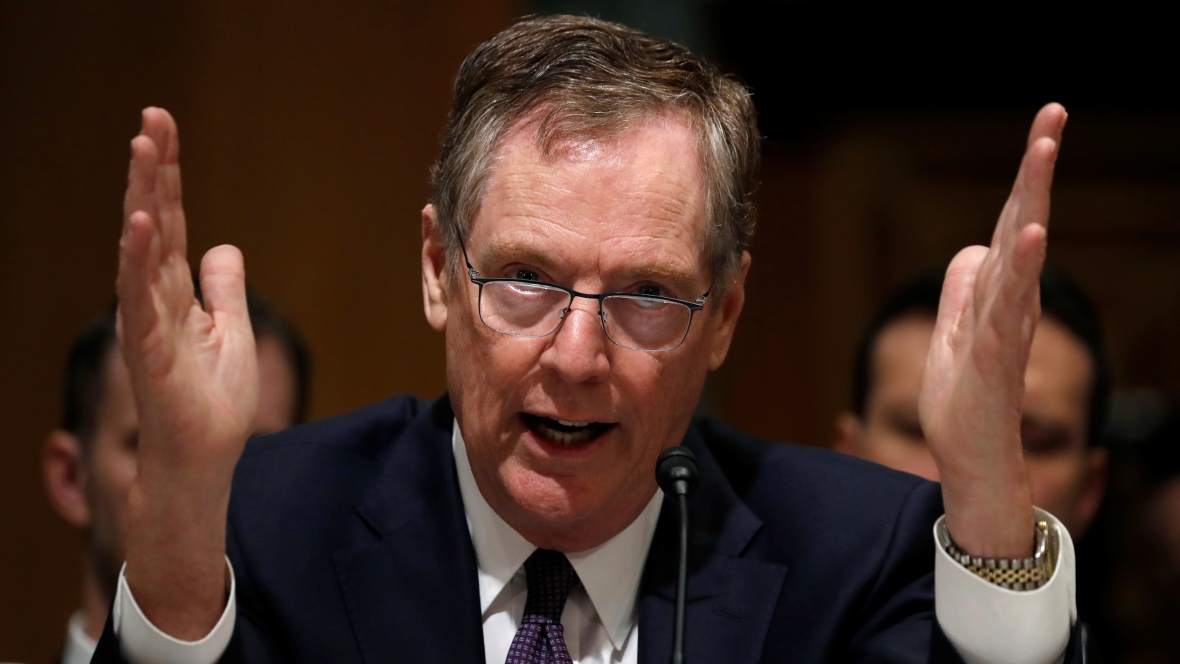 |
| US Trade Representative Robert Lighthizer this Thursday at the Senate Finance Committee (Kevin Lamarque - Reuters) |
Some of the United States’ closest trading partners will
receive a temporary reprieve from tariffs on aluminum and steel imports, the
top US trade official said Thursday, a day before the measures were set to
begin. The curbs were expected to be imposed on Friday (23rd March), two weeks
after Trump’s signature.
The decision was sure to relieve anxious U.S. partners,
even as it raised questions about whether the tariffs would be able to protect
US metal industries. Brazil, Argentina, the European Union, South Korea and
Australia are on the list US Trade Representative Robert Lighthizer announced
at a Senate hearing. Canada and Mexico already had been exempted.
World leaders had subjected Washington to a furious
lobbying effort to remove the tariff, announced by President Trump earlier this
month, warning of a trade war and saying that they did not see why
long-standing military allies should face the import taxes on national security
grounds, the professed basis for Trump’s action.
“The idea that the president has, is that based on a certain
set of criteria, that some countries should get out,” Lighthizer told the
Senate hearing. “What he has decided to do is to pause the imposition of the
tariffs with respect to those countries.”
Lighthizer said Wednesday that he expected that
negotiations about permanent exemptions to the tariffs would be resolved by the
end of April, creating pressure on the countries to reach a deal with
Washington on measures that would satisfy Trump’s desire to improve their trade
relationships with the United States.
Following the exemptions, the countries that will be hit
hardest when the steel tariffs take effect Friday will be Russia, Taiwan and
Turkey.
Temer:
US will start “negotiations” with Brazil
In an announcement made Wednesday (21st March), Brazilian
President Michel Temer said the US would start negotiations with Brazil over
the new import tariffs on steel and aluminum. While talking about the measure,
unveiled in a note by the US government just at that moment, Temer said the new
tariff will not be introduced before negotiations are brought to an end.
“I’m looking at a declaration by the White House saying
that Brazil is one of the countries with which negotiations are to begin with a
view to waiving import tariffs on steel and aluminum. The new tariffs, the
message from the White House says, will not apply until conversations are held
on the topic. Good news,” the Brazilian President said, during a meeting with
the Economic and Social Development Council (CDES).
On Tuesday, Temer talked to a representative from
Brazil’s steel-producing industry. In the conversation, the President availed
himself of arguments to convince US President Donald Trump to exempt Brazil
from the new tariff.
Sources: Agência Brasil, Reuters, The Washington Post
12 março, 2018

Brazilian Finance Minister Henrique Meirelles said that
the country is to consider talks with the US on the 25% tariffs on imported
steel, a measure signed Thursday (Mar. 8) by President Donald Trump.
“The Government signed that; it should be in effect in 15
days, but they’re saying they’re open to negotiation. We just have to know what
sort of negotiation this is; what they’re willing to negotiate. The issue will
be considered bearing in mind what Brazil has to win or lose,” Meirelles said
in New York, where he is taking part in an event aimed at drawing foreign
investment to Brazil.
In his view, the decision made by the US Government is
detrimental to all parties involved. “It benefits steel production and protects
the employment of a group of workers in steel-producing companies. But it’s
harmful, it takes the jobs of industrial companies using steel or aluminum;
companies that lower their international competitiveness for having more
expensive supplies.”
The Brazilian Government released a note last Thursday
(8) stating that the decision by the US Government should cause “significant losses”
in Brazil, and make an impact on “trade and investment ties between the two
nations.”
Altogether, 32% of the steel exported by Brazil is bound
for the US, which makes Brazil second only to Canada in steel exports to the
US. In 2017 alone, 4.7 million tons of Brazilian steel were shipped to the US,
which totaled $2.6 billion in revenues.
Trump's tariffs could ricochet on US coal country
Metallurgical coal — or “met coal” — is low-ash,
low-sulfur coal that’s used to produce coke, an essential fuel for steel-making.
Last week, Brazil reminded US officials that it’s the
biggest buyer of American met coal – about $1 billion worth last year – in a
statement expressing concerns over the tariffs.
Latin America’s largest economy imported nearly 5.2
million tons of US met coal through September of last year – about 1.3 million
more than the next highest consumer, Japan, according to the U.S. Energy
Information Administration.
The Brazilian statement also pointed out that US and
Brazilian steel industries are not competitors, but are integrated and
complement each other. “Approximately 80% of Brazilian steel exports are
semi-finished products that are used as inputs in the US steel industry. Moreover,
Brazil is the largest buyer of metallurgical coal from the United States,
chiefly for the manufacture of Brazilian steel for export to the United States”
said the note.
Brazil also said it would not rule out retaliating
against proposed tariffs. Similarly, a European Union trade leader has
threatened to impose tariffs on US made products like steel, cars, orange juice
and Kentucky bourbon.
26 abril, 2017

The European Union and Mercosur should intensify talks to
advance in theirs trade agreement this year, Spanish Prime Minister Mariano Rajoy
said on Tuesday (25/04), urging after 18 years of negotiations.
Rajoy’s comments at a trade event in the city of São
Paulo reinforced a 2017 target proposed on Monday (24/04) by the Argentinian
Foreign Minister Susana Malcorra and EU Ambassador to Brazil João Cravinho, who
said a deal could be ratified in 2018 and implemented in 2019.
Rajoy said an accord is “closer than ever” and
highlighted opportunities for Spanish investments in Brazilian infrastructure,
energy and transportation sectors. Spain has been the second-largest source of
foreign investment in Brazil after the United States.
Brazilian Foreign Minister Aloysio Nunes said that
Mercosur must focus on lowering its internal trade barriers to ease talks with
Brussels, questioning disparate price schemes for Brazilian and Argentinian
produce, for example.
Mercosur founding members, which also includes Uruguay
and Paraguay, began negotiations with the European Union in 1999, broke them
off in 2004 and resumed talks again in 2010.
Malcorra suggested on Monday that a United States retreat
from global trade talks had opened a window for the European Union to become a
strong player in multilateral accords between regions.
Sources: Agência Brasil, Mercopress Agency, Itamaraty
11 janeiro, 2017

Negotiations for an ample trade and cooperation agreement between the European Union and Mercosur are strategic, essential and must be urgently concluded, said Ramon Jauregui, head of the Euro-chamber for Latin America delegation, following on the recent accords signed by the EU with Ecuador and Cuba.
“Mercosur is of enormous significance for Europe and we are entering a context of uncertainty with the arrival of Donald Trump to the White House”, pointed out Jauregui, a member of the European Parliament who added the urgency of signing the agreement which is pending since 1999 and was re launched in 2010.
Jauregui admitted that items such as beef, rice and sugar are considered “vulnerable” for Europeans and non-negotiable for Mercosur, despite the fact that the EU Agriculture Commissioner Phil Hogan last November called on the South American block to moderate its aspirations.
However Mercosur sources indicate that the three are part of an EU ten-item sensitive list and argue the accord has a raft of benefits for Europe regarding manufacturing, auto-parts, the chemical industry, among others.
Nevertheless Mercosur sources indicate that 2017 represents “a window of opportunity”, not necessarily to conclude the accord but to advance and give the talks credibility and a sense of irreversibility.
In effect and looking ahead to the new round of talks scheduled for next March in Buenos Aires, both sides have agreed to leave for further on the “sensitive lists”, which includes in effect beef and ethanol. Argentina is one of the world's leading exporter of ethanol.
But EU has its own problems: France is holding presidential and legislative elections in the first half of this year and has expressed concern about agriculture, a decisive sector for any aspiring political force wanting to reach Paris. Jauregui feels this is clear evidence of a lack of unity among the 28-member EU when they have to face a Trump administration in Washington.
Mercosur has a more positive approach according to statements from Brazilian foreign minister Jose Serra, “with Brexit and Trump's victory, friends must unite”. In effect Jauregui has pleaded EU Foreign affairs commissioner Federica Mogherini “to take advantage” of the current situation when all indicates that a Trump administration might very well emphasize a protectionist policy.
Likewise a potential vacuum in Latin America could be occupied by China, despite the close historic and cultural roots with Europe, and not forgetting that most of manufactured goods or with added value from Latam are exported to Europe, thus “Europe should stop looking at its belly button and concentrate in Latin America”.
Finally Jauregui recalls that 2017 took off with the EU trade agreement with Ecuador, and joins Colombia and Peru, and in coming months a similar scenario will take place with Cuba, conditioned to cooperation in human rights issues.
“Let's not forget the significance of these latest moves, since Trump has anticipated he will turn back all the agreements reached by the US with Cuba, under the Obama administration”.
Source: Mercopress Agency
03 novembro, 2016

Jorge Taiana, President of Mercosur’s Parliament (Parlasur), said that the European Union’s current trade offer is “unsatisfactory” and made it clear that it shouldn’t be signed in its present form. Taiana complained that the negotiations, which resumed about seven years ago, are taking far too long, but added that in the absence of a “balanced agreement”, nothing should be signed.
The lawmaker said that the EU’s offer of “small tolls on unprocessed products” and its demand that “Mercosur open up its industries and services” would negatively affect “integrated and balanced development”. He also added that he is “not optimistic that there will be progress” as a result of the economic recession that has hit Europe.
In this situation, Taiana indicated that more regional measures and promotion of trade in materials and services between Latin American countries would be more viable. In the case of Argentina, he insisted that the business relationship with Chile “will not change”, regardless of the talks going on with the EU.
German Eurodeputy Bernd Lange (SPD), chair of the European Parliament’s Committee on International Trade, said he was more optimistic than Taiana and indicated that he is hopeful that these new negotiations will not last as long as those that were needed to finally secure the Canadian trade deal, known as CETA.
Lange insisted that the fact our world is ever-more globalized is a reason to broker agreements that “configure” this phenomenon and which do not just focus on “stronger” economic benefit, but more on “fair trade”.
The German lawmaker said that next March there will be new meetings and highlighted that the Parliament is “a key player” in managing the relationship between the two parties.
Parlasur is comprised of 81 Deputies, 18 from each member state and 9 from candidate member Venezuela. It was established to boost the political autonomy of Mercosur and its first session was held in early 2007, but its initiative is very much limited.
Source: Mercopress Agency
Assinar:
Postagens (Atom)
Postagens populares
-
 Ministério cria projeto para estimular a participação política de mulheres O Ministério da Mulher, Família e Direitos Humanos publicou nest...
-
 Vídeo em poder da força-tarefa da Operação Lava Jato, exibido pelo Jornal da Globo, mostra uma reunião em que o então presidente do PSD...
-
 Hoje na Câmara dos Deputados: tramitação está na fase 13 Acompanhe ao vivo A comissão especial que analisa o projeto que estabe...
-
 Photo: Ueslei Marcelino/Reuters Brazil's government relaxed its budget targets until 2020 this Tuesday, delaying prospects for a d...
-
 Foto: Leonardo Berenger / Agência Berenger O ex-deputado e ex-governador do Rio de Janeiro Anthony Garotinho (PR) foi preso por volta ...


