


Mostrando postagens com marcador South Korea. Mostrar todas as postagens
Mostrando postagens com marcador South Korea. Mostrar todas as postagens
22 março, 2018
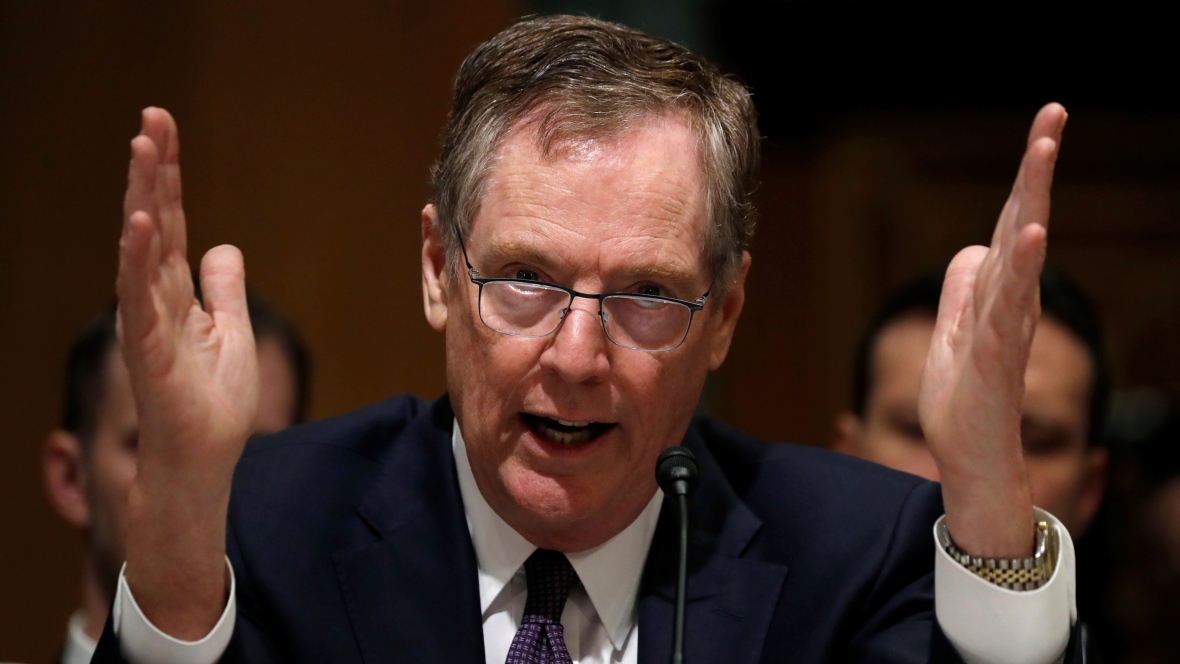 |
| US Trade Representative Robert Lighthizer this Thursday at the Senate Finance Committee (Kevin Lamarque - Reuters) |
Some of the United States’ closest trading partners will
receive a temporary reprieve from tariffs on aluminum and steel imports, the
top US trade official said Thursday, a day before the measures were set to
begin. The curbs were expected to be imposed on Friday (23rd March), two weeks
after Trump’s signature.
The decision was sure to relieve anxious U.S. partners,
even as it raised questions about whether the tariffs would be able to protect
US metal industries. Brazil, Argentina, the European Union, South Korea and
Australia are on the list US Trade Representative Robert Lighthizer announced
at a Senate hearing. Canada and Mexico already had been exempted.
World leaders had subjected Washington to a furious
lobbying effort to remove the tariff, announced by President Trump earlier this
month, warning of a trade war and saying that they did not see why
long-standing military allies should face the import taxes on national security
grounds, the professed basis for Trump’s action.
“The idea that the president has, is that based on a certain
set of criteria, that some countries should get out,” Lighthizer told the
Senate hearing. “What he has decided to do is to pause the imposition of the
tariffs with respect to those countries.”
Lighthizer said Wednesday that he expected that
negotiations about permanent exemptions to the tariffs would be resolved by the
end of April, creating pressure on the countries to reach a deal with
Washington on measures that would satisfy Trump’s desire to improve their trade
relationships with the United States.
Following the exemptions, the countries that will be hit
hardest when the steel tariffs take effect Friday will be Russia, Taiwan and
Turkey.
Temer:
US will start “negotiations” with Brazil
In an announcement made Wednesday (21st March), Brazilian
President Michel Temer said the US would start negotiations with Brazil over
the new import tariffs on steel and aluminum. While talking about the measure,
unveiled in a note by the US government just at that moment, Temer said the new
tariff will not be introduced before negotiations are brought to an end.
“I’m looking at a declaration by the White House saying
that Brazil is one of the countries with which negotiations are to begin with a
view to waiving import tariffs on steel and aluminum. The new tariffs, the
message from the White House says, will not apply until conversations are held
on the topic. Good news,” the Brazilian President said, during a meeting with
the Economic and Social Development Council (CDES).
On Tuesday, Temer talked to a representative from
Brazil’s steel-producing industry. In the conversation, the President availed
himself of arguments to convince US President Donald Trump to exempt Brazil
from the new tariff.
Sources: Agência Brasil, Reuters, The Washington Post
21 março, 2017
 |
| Photo: Presidência da República/Beto Barata |
In
a statement made Monday (Mar. 20), the Brazilian President Michel Temer said
the issues uncovered at meat processing plants by the Federal Police as part of
Operation “Weak Flesh” affect only a small part of the sector. “Agribusiness is
of the utmost importance to us and must not lose its value on account of a
small core, something that will shrink in size: it can be investigated,
monitored, and punished whenever necessary. But we must not compromise the
whole system we've been putting together over the years. We've been exporting
to over 150 countries,” the president told an audience of investors at the
headquarters of the American Chamber of Commerce, in São Paulo.
The
crackdown was launched last Friday (17) and targeted some of the country's
biggest food giants, like JBS, BRF, and Peccin, accused of committing a number
of frauds to conceal the use of expired or low-quality material in food
production.
Temer
noted that the number of public officials implicated (33) is small compared to
all 11 thousand officials in the Ministry of Agriculture. “Our sanitary
assessment systems here in Brazil are extremely rigorous,” he stressed. The
officials are being accused of pocketing bribes in exchange for releasing
products that did not comply with the regulations. He went on to say that the
number of plants under suspicion (21) is small, taking into consideration the
whole of the sector, which includes over 4.8 thousand establishments.
The
president further mentioned the several meetings he held in recent days both to
become acquainted with the topic and to reassure the countries buying Brazilian
foods. “I've been to a number of meetings in Brasília, first with the ministers
from the areas involved in the issue, then with the associations of meat
producers of all kinds, as well as the ambassadors from the countries importing
Brazilian meat. We ended up in a
fraternal atmosphere last night, eating barbecue with all the representatives
of the countries in attendance,” he said.
China
temporarily bars Brazilian meat from entry
China suspended the entry of Brazilian meat in the
country until Brazil provides clarification regarding Operation “Weak Flesh”.
In a note, the Brazilian Ministry of Agriculture,
Livestock, and Supply announced it will provide all clarifications to the
Chinese as quickly as possible. “Until it received the information, China will
not allow the meat from Brazil to land. Minister [Blairo Maggi] said he will
hold a video conference with Chinese authorities to provide the
clarifications,” the statement says.
According
to news agency Xinhua, Brazil's exports to China nearly doubled in the first
two months compared to the same period in 2016. In January and February, the
exports raised $6.246 billion, mostly through the sale of oil and iron, soy,
wood pulp, and beef. The value of Brazil's exports to China leaped 94.3%,
driven by an increase in the price of raw materials like oil and iron.
On
Monday morning, a ruling from the ministry removed federal superintendents for
agriculture, livestock, and supply Gil Bueno de Magalhães in Paraná, and Júlio
César Carneiro in Goiás. On
Friday, after the launch of the Weak Flesh probe by the Federal Police, the
government had announced the ouster of 33 government officials suspected of
being involved in the irregularities being investigated.
The investigators believe that the processing plants
implicated in the scheme “masked” spoiled meat and repackaged them to sell
them. The companies bribed government-appointed inspectors in exchange for
allowing the products to be traded without due inspection.
Chile
and South Korea
China's was the only suspension confirmed by the Brazilian
Ministry of Agriculture. However, according to news agency DPA, Chile's
Agriculture Minister Carlos Furche announced that the country barred Brazilian
meat from entry until further clarifications on the scope of the scheme are
provided.
By contrast, South Korea overturned its decision to bar
Brazilian meat imports. In his opening speech at the 2017 Latin American Cities
Conference, in Brasília, Temer further said he is not familiar with all the
details concerning the current position of the South Korean government, but he
believes it came as a reaction to the clarifications provided by the Brazilian
authorities.
The president noted he has already ordered the creation
of a task force to further probe into the irregularities and mentioned the
measures adopted to prevent the economy from suffering any more harm. “The
officials [charged] were ousted by the minister of agriculture, Blairo Maggi,
yesterday”.
Source: Agência Brasil
Assinar:
Postagens (Atom)
Postagens populares
-
 Photo: Repsol Agency The Overview Very recently, on June 7, the Brazilian National Oil, Natural Gas, and Biofuels Public Agency (ANP...
 -
 O Congresso Nacional terá sessão na terça-feira (15), às 19 horas, para analisar cinco vetos presidenciais que trancam a pauta e os projet...
 -
 Foto: Estadão Novo relator da Operação Lava Jato depois da morte de Teori Zavascki, o ministro do STF Edson Fachin acatou pedido do Pro...
 -
 11/09/2015, 17h46 Wilson Dias / Agência Brasil A defesa final da presidente Dilma Rousseff sobre as contas do governo...
 -
 Após mais de 9 horas de debates, trocas de acusações e gritos de “Fora Dilma” e de “Não vai ter golpe”, a Comissão Especial do Impeachment...


