


Mostrando postagens com marcador Brazilian Economy. Mostrar todas as postagens
Mostrando postagens com marcador Brazilian Economy. Mostrar todas as postagens
21 janeiro, 2019
 |
| Photo: Adriano Machado - Reuters |
The Brazilian President Jair Bolsonaro will outline his
government’s economic reform agenda and plans to increase trade with the rest
of the world during his speech at the World Economic Forum’s Annual Meeting in
Davos today.
Bolsonaro, a far-right former Army captain who took
office on Jan. 1st vowing to end years of graft and crack down on violent
criminals, will also pledge to lower rampant bureaucracy in Brazil, which many
view as a drag on the country’s stuttering economy.
Bolsonaro’s 40-minute speech is scheduled for Wednesday,
and he will also highlight efforts to simplify the economy, while pledging to
give legal certainty to investors and defend the rule of law.
Bolsonaro is also expected to comment on the situation in
neighboring Venezuela, which is undergoing an unprecedented crisis and growing
international pressure against the regime of President Nicolás Maduro.
A long-standing critic of Maduro, Bolsonaro has ruled out
military action to overthrow the current government, but said last week that a
solution for Venezuela will come “briefly,” without giving details of how that
would happen.
On his return from Davos, Bolsonaro will settle on a
model for its pension reform proposal, his chief of staff, Onyx Lorenzoni, said
on Tuesday.
Sources: Agência Brasil, Reuters
13 junho, 2018
 |
| Photo: Repsol Agency |
The Overview
Very recently, on June
7, the Brazilian National Oil, Natural Gas, and Biofuels Public Agency (ANP, in
Portuguese) sold three of the four blocks offered as part of the fourth pre-salt
auction. Bonuses added up to US$ 807,7 million. The deep waters pre-salt oil
reserves discoveries in Brazilian coast are among the most important made in the world over
the last decades.
The most coveted block
and the first to be won — called “Uirapuru”, on Santos basin — was won by a
consortium formed by the Brazilian State-owned Petrobras (30%), Portugal’s Petrogal
(14%), Norway’s Statoil (28%), and ExxonMobil (28%). The bid surpassed the 22,18%
minimum set for the auction. The premium stood at 240,3%. The signing bonus was
US$ 679,5 million.
Brazilian authorities
stated that with a profit oil of 75,49% for “Uirapuru” block, the Brazilian
Government is likely to receive 90% of the project’s net revenues. These are
values hardly ever seen, including in auctions for blocks in the Middle East.
Deducting companies’ investments and costs of the projects’ net revenues, 90%
will go to the Brazilian Treasury.
Also located on Santos
basin, the “Três Marias” block attracted two bidders. The winning consortium is
formed by Shell Brasil (40%), Chevron Brazil (30%), and Petrobras (30%). In
turn, the “Dois Irmãos” block, on Campos basin, was won after a single bid by
Petrobras (45%), BP Energy (30%), and Statoil Brasil O&G (25%), with a zero
premium and a percentage of 16,43% of oil handed over to the government. The
signing bonus stood at US$102,56 million. On the same basin, the “Itaimbezinho”
block got no offers.
ANP has set the
deadline for the payment of signing bonuses for September 28. The bonus is
based on the market’s expectations on the production potential of the blocks on
sale and the degree of competitiveness in the area auctioned. Contracts are to
be signed by November 30.
In all, the Brazilian
Government expects to receive US$ 5,82 billion in proceeds from licenses and
concessions.
The
Quorum’s view: Oil sector in Brazil - a good opportunity, with its risks
involved
Despite the institutional instabilities in the
Brazilian society in recent years, the future of the Brazil’s Oil sector – and,
by extension, of its general economy – is positive in a long-term.
Consequently, foreign investors willing to opperate in this sector should be
capable to accept “ups and downs” in the short-term.
Oil and Natural Gas sector accounted for 11% Brazil’s
GDP in 2017 and the perspective is the continuity of this growing. With a
recovered economy in the future (and the permanence of the economic and
political collapse situation in Venezuela), Brazil has a strong chance to
mantain its position as the largest oil producer in Latin America. In this
scenario, pre-salt will be one of the most promising oil reserves in the world.
The Brazilian Government expects the auctions related to pre-salt basins to yield investments of about US$ 36 billion for the next 10 years, and would create about 500.000 direct and indirect jobs. This development in the oil sector would provide an optimistic outlook for many Brazilian states’ economy that depend on oil production, such as Rio de Janeiro, Espírito Santo and São Paulo states. This sector recovery could invite more economic development in Brazilian states that have suffered from the recent dire economy.
The Brazilian Government expects the auctions related to pre-salt basins to yield investments of about US$ 36 billion for the next 10 years, and would create about 500.000 direct and indirect jobs. This development in the oil sector would provide an optimistic outlook for many Brazilian states’ economy that depend on oil production, such as Rio de Janeiro, Espírito Santo and São Paulo states. This sector recovery could invite more economic development in Brazilian states that have suffered from the recent dire economy.
However – despite advances made by “Lava Jato” investigations –, corruption,
fraud, and bribing will remain real problems in Brazil in the next few years. Nevertheless
– to atract foreign investments to the sector –, the Brazilian administration is
concerned to reinforce regulatory and economic laws to mitigate these risks in
the oil and gas industry.
Thus, despite the positive developments in the oil
sector, there are persistent political risks that investors must consider.
These risks include excessive jurisprudencial changing in the Brazilian
judiciary system, reputational damage related to the interaction to the
high-level corruption, political intervention with the involvement of Petrobras
and impositive contract changes. For instance, the effects of the Truckers’ Strike on the
pricing policy of Petrobras (that become partly controlled after the Strike), two weeks ago, caused the resignation of Pedro Parente, chairman of that State-owned (who
advocated for a policy of free prices fluctuating in according to international
markets). These events provides a cautionary tale for investors who seeking
short-run profits, as judicial and political insecurity can undermine the
business environment. Along with these issues, the upcoming presidential
elections on next October could reverse policies and new regulatory framework
for oil sector.
All in all, it’s necessary to say that the Brazilian
energy sector (in special, its oil industry) usually creates great
opportunities of profitability to patient investors with capacity of short-run
resilience and a strategic approach to deal with Brazilian way of doing business.
To foreign investors, a robust strategy
to the Brazilian markets involves a learning process related to the political
and corporate local cultures which permits the identification of opportunities
with the risk mitigation. In this field, the accompaniment of a specialized
team on political risk analysis (with focus on Brazil) can be a strong
watershed between the success and the failure.
Quorum Political Strategy is a government relations and political risk
consulting firm made up of experienced professionals who can help your
organization achieve its goals. We are a result-oriented consulting firm. Do
not hesitate to contact us.
01 junho, 2018
 |
| Photo: Sergio Moraes/Reuters |
The Chief Executive of Brazil´s state-controlled oil
giant Petrobras, Pedro Parente, decided to step down from his post Friday (June
1). The decision was made public in an urgent announcement to the market.
Parente met with President Michel Temer at the Planalto presidential palace.
The statement released by Petrobras says that “the
appointment of an acting CEO will be considered by the firm’s managing board
later today. The remaining members of the company’s board of executives will
not undergo any changes.”
At 11:20 am, after Parente’s decision to resign was made
public, a plunge was observed at the São Paulo stock exchange. The firm also
reported that the trading of its PETR-N2 shares was suspended from 11:22 to
11:42 am, but was subsequently resumed.
Surprise
Petrobras Chief Executive quit this Friday is a surprise
move that wiped some $12 billion off the state-controlled oil producer’s market
valuation, after Brazil’s government responded to a trucking strike by
intervening in the company’s fuel pricing policy.
Pedro Parente, who in two years in the job had succeeded
in slashing Petrobras’ debt and restoring it to profitability, said in a
resignation letter to President Michel Temer it was clear after the last week’s
turmoil that new talks would be needed on pricing policy.
“Given this situation, it has become clear that my
remaining as CEO of Petrobras has stopped being positive and will not
contribute to the alternatives that the government must consider going forward,”
Parente said in the letter.
Shares in Petrobras, Latin America’s biggest oil
producer, plummeted as much as 15 percent in afternoon trading, wiping some 45
billion reais ($12 billion) from the company’s capitalization and pushing
Brazil’s wider Bovespa index into negative territory. The real currency
weakened as much as 1 percent against the dollar. Petrobras bonds also fell.
Still, his resignation appeared to have taken Temer’s
already beleaguered government by surprise. A senior presidential source told
on Thursday that no such move was expected.
Truckers’
Strike Impact
A key plank of Parente’s turnaround campaign for the
company and a condition for his taking the top job in 2016 was freedom to
control fuel prices. He sought to align those more closely with international
markets through nearly daily price adjustments.
But on Sunday Temer, governing with rock-bottom approval
ratings, announced plans to placate the striking truck drivers - who were
protesting the high cost of diesel - by freezing fuel prices on a monthly basis
and taking other measures to bring domestic diesel prices down.
Truckers have gradually returned to work since then,
after a protest that left gas stations and some airports without fuel and
supermarket shelves bare.
“The policy (Parente) put in place was the scapegoat of
this whole crisis,” said Roberto Castello Branco, a former Petrobras board
member, arguing that Temer’s weakened government must have asked Parente for
changes he could not accept. “The pressure on him was enormous.”
“Terrible
Administrator”
While investors and oil industry insiders bemoaned his
departure, others rejoiced.
“Parente was the most responsible for the crisis that
Brazil has faced with the trucker strike,” the truckers lobby said in a
statement. “Nothing justifies the abusive diesel prices put in place by the company
in the last few months.”
Petrobras oil workers, who walked off the job earlier
week in part to demand Parente’s dismissal, also celebrated.
“Pedro Parente, you will go down in history as a terrible
administrator, who took gasoline away from Brazilians,” Jose Maria Rangel,
leader of FUP, Brazil’s largest oil workers union, said in a video message.
“You don’t deserve to walk through the doors of Petrobras again.”
Parente’s departure comes days before Brazil hopes to
attract foreign oil companies to bid on oil fields in its coveted “presalt”
exploration areas and leaves in limbo several of his key priorities, including
selling major refineries.
Also unresolved is a long-running dispute with the
government over an oil-rich offshore area, which could represent a windfall for
Petrobras if a deal is reached.
Sources: Agência Brasil, Reuters
27 novembro, 2017
 |
| Photo: Beto Barata/PR |
A new version of Brazil’s unpopular Pension Reform bill
presented last Wednesday will suggest “softer” rules for retirement and social
security contributions, according to a draft of the legislation that the Government
hopes will win approval in Congress.
The new bill will require a minimum of 15 years of
contributions from private sector workers, compared to 25 years in the previous
draft bill and 15 currently. Public servants would have a 25-year minimum, and
all workers would need to work 40 years to retire on full pension.
The
bill maintains the minimum retirement age of 65 years for men and 62 years for
women, a key proposal for reducing the cost of Brazil’s pension system.
Pension
reform is the cornerstone policy in President Michel Temer’s efforts to bring
the deficit under control, but he lacked the votes to get a tougher version
approved by lawmakers who worried the unpopular measures would hurt their
re-election chances next year.
Temer used political capital blocking corruption charges
that further undermined support for his policies and delayed a pension reform
vote in Congress by six months.
The
revamped bill maintains the same retirement rules for rural workers that are in
effect now, dropping proposals for tighter standards.
In
the current bill, rural workers will contribute for 15 years to get a pension,
10 years less than the Government’s initial proposal. The minimum retirement
age for female and male rural workers will be kept respectively at 55 and 60
years, the same as today, according to the draft.
The Government
restored a guarantee that disabled or elderly people unable to support
themselves would receive an additional amount so their total payment meets a
monthly minimum,
The
speaker of the Lower House of Congress, Rodrigo Maia, warned this week said
that the government did not have the 2/3 majority of votes needed to pass a Pension
Reform.
Maia
said the government should work to strengthen its base first, which Temer
sought to do on Wednesday by swearing in Alexandre Baldy to head the Ministry
of Cities, a move designed to please the Baldy’s Progressive Party (right
wing), which has 40 seats in the chamber.
Source:
Mercopress Agency
23 setembro, 2017
 |
| Photo: Marcelo Camargo - Agência Brasil |
Brazil’s Central Bank trimmed its inflation forecast on
Thursday and said it expected economic growth to pick up into next year,
painting an optimistic picture for Latin America’s largest economy as interest
rates approach record lows.
In a quarterly inflation report, the Central Bank
forecast economic growth of 0.75% in 2017, up from a previous estimate of 0.5%.
For 2018, the Bank forecast growth of 2.2%. Inflation is estimated at 3.2% in
2017 and 4.3% in 2018, down from 3.3% and 4.4% respectively that it expected
previously.
The Central Bank, which has slashed interest rates from
14.25% to 8.25% over the past year to revive a recession-hit economy,
maintained its forecast of gradually reducing the pace of interest rate cuts in
coming months.
The Bank extended its inflation scenario to include
forecasts for 2019 and 2020, at 4.2% and 4.1% respectively. With inflation
estimates hovering around the official target of 4% for 2020, policymakers said
monetary policy can continue to stimulate economic growth.
Economists expect the bank to cut its benchmark interest
Selic rate to 7.00 percent by December, below an all-time low of 7.25%t, and
keep the rate at that level through 2018, a weekly central bank survey showed
on Monday.
Brazil’s economy resumed growth in the first half of this
year after 3 years of its worst recession on record. While stronger consumption
has driven the gradual recovery for now, investments are expected to grow 3% in
2018 thanks to lower interest rates, the bank predicted.
Temer Presidency: deep disapproval among Brazilians
Nevertheless, approval for Brazilian President Michel
Temer's government has plummeted, according to a poll published on Tuesday, as
the scandal-plagued leader faces new corruption charges and struggles to push
his economic reform agenda through Congress.
Polling firm MDA said that only 3.4% of those surveyed
thought the Temer government was doing a “great or good” job - down from 10.3%
in MDA's last such poll in February.
Temer took over a year ago from impeached leftist Dilma
Rousseff and has said he does not care about popularity and only wants to push
through an austerity package before his term ends in Jan. 2019. Yet his ability
to do so has been hamstrung by charges of taking bribes, racketeering and
obstruction of justice.
The charges against Temer are based on the plea-bargain
testimony of the owners of the world's largest meatpacker, JBS SA. They
accuse Temer of taking bribes in return for political favors and of conspiring
to buy the silence of a witness who could implicate the leader. Temer has
repeatedly denied any wrongdoing.
The
MDA poll was commissioned by the national transport lobby CNT and surveyed
2,002 people across Brazil from Sept. 13-16. The poll has a margin of error of
2.2 percentage points.
Source:
Mercopress Agency
16 agosto, 2017
 |
| Photo: Ueslei Marcelino/Reuters |
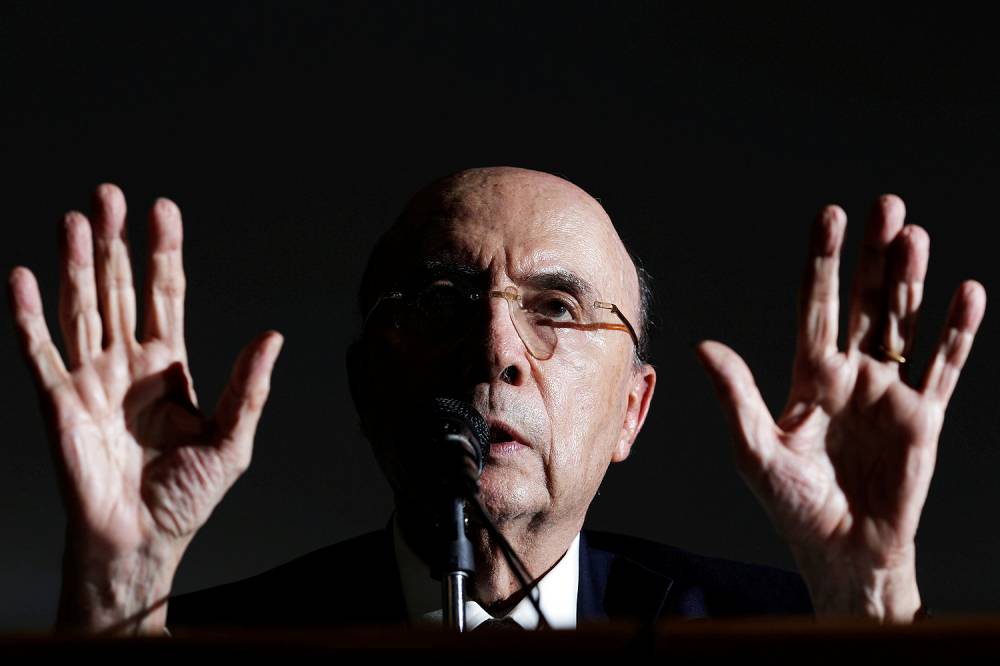
Brazil's government relaxed its budget targets until 2020 this Tuesday, delaying prospects for a drop in the federal deficit after legislators repeatedly refused to raise taxes in the recession-hit economy.
Cost-cutting measures were announced along with the new targets, in a bid to demonstrate President Michel Temer's commitment to fiscal discipline even after his economic team cut forecasts for economic growth next year.
The revision, announced weeks earlier than expected, underscored the uphill battle for Temer to gather support for austerity measures as a corruption scandal simmers and next year's general elections approach.
Market reaction was muted as investors did not expect a surge in government spending despite the new targets. Ratings agency Standard & Poor's spared Brazil from a downgrade, saying after the announcement that it would maintain the country's debt rating at BB with a negative outlook.
Brazil's government set a new primary deficit target for this year and next of R$ 159 billion ($49.7 billion), up from R$ 139 billion this year and R$ 129 billion for 2018.
The country will target a deficit of R$ 139 billion for 2019, up from R$ 65 billion previously. For 2020, it will aim for a R$ 65 billion deficit compared with a R$ 10 billion surplus previously - raising prospects of a seven-year-long period of consecutive budget deficits, started in 2014.
Members of Temer's economic team, including Finance Minister Henrique Meirelles, previously wanted to wait until September to consider a looser budget target, but agreed to move up talks under pressure from a fractious coalition in Congress.
Most cost-cutting measures announced by Meirelles and Planning Minister Dyogo Oliveira this Tuesday will need Congress' approval. They include postponing public sector salary hikes by one year and reducing the entry salary for incoming civil servants.
Despite strong opposition to tax hikes, Meirelles said the government would still seek to roll back payroll tax breaks and would raise taxes on some investment funds.
The government did not announce expected infrastructure concessions. It forecast 2% growth in 2018, down from a previous estimate of 2.5%.
Congress leader says Brazil Government doesn't have votes to pass social security reform
The Speaker of Brazil's Lower House said Tuesday the government doesn't have the votes to pass a social security overhaul that is key to President Michel Temer's economic agenda.
The comments by Chamber of Deputies Speaker Rodrigo Maia came after a meeting with Finance Minister Henrique Meirelles as well as the leaders of the parties in congress.
"It would have been ideal to approve the reform today," Maia said, arguing that it was the only straightforward solution to the country's economic crisis.
The government would need 308 votes to pass the constitutional amendment in the 513-member Lower House.
Temer, whose approval rating was 5% in the latest national poll, has been counting on his proposals for loosening work rules and changing pensions to revive the economy and help save his Presidency. Failure to pass them could undermine crucial support for him and could leave him vulnerable to a second round of corruption charges.
The pension overhaul is less appealing to congressmen looking ahead to the 2018 general elections.
The Chamber of Deputies recently voted against sending Temer to trial on a bribery charge. However, the mounting pressure on the President weakened his governing coalition in the lead-up to that vote and has put the brakes on his economic agenda.
Temer could also face new accusations in the near future.
The Chamber of Deputies recently voted against sending Temer to trial on a bribery charge. However, the mounting pressure on the President weakened his governing coalition in the lead-up to that vote and has put the brakes on his economic agenda.
Attorney General Rodrigo Janot, who filed the bribery charge against the President, said last week that plea bargains being negotiated could lead to new charges against Temer. Janot's term as Brazil's top lawman ends September 17th, meaning his time is running short to deliver on his warning.
Sources: Reuters, Agência Brasil
11 março, 2017

Brazil's
official inflation, as measured by the National Broad Consumer Price Index
(IPCA) is expected to close out the year below the center of the target (4.5%).
The estimate was made by the Institute for Applied Economic Research (IPEA),
which released its report on the first quarter of 2017. The institute did not
announce a specific estimate for the IPCA, but merely declared it should end
the year below 4.5%.
After
last year's deflation, the institute reported, fixed prices (like energy,
transport and other public fees) are to face a slight hike this year. The
phenomenon is expected to raise inflation in the last quarter, but not enough
to exceed the center of the target.
Food
According
to IPEA, price rates are expected to slow further down for the rest of the
year, thanks to the behavior of free prices. Most noteworthy are food prices,
which should face a weaker increase this year, or even decline in some cases,
as a result of the increase in grain harvests and oil-producing plants and not
as a result of climate phenomena in the main producing regions, as has been the
case over the previous years.
As
for decisive external factors, IPEA reported that the price of commodities will
hold steady chiefly for three reasons. Oil extraction will be counterbalanced
by the increase in the US production of shale oil, the havests in both
hemispheres are expected to rise, and China's decision to curb economic growth
should pull down the globe's demand for iron ore.
Source:
Agência Brasil
02 janeiro, 2017

Brazil is getting ready for a blockbuster 2017 harvest and booming exports, amid favorable weather forecasts, according to recent estimates. With a plentiful harvest expected, Brazil’s National Grain Association predicts grain exports will rebound, with soybean exports of 60 MT in 2017, compared with some 51 MT for 2016. Corn exports will increase to 30 MT, compared with some 18.5 MT in 2016, the association reported.
Brazil’s crops are in very good condition across the country’s vast 4 million-square-kilometer cropland region. Dryness in southern Brazil’s Mato Grosso do Sul state and the western Bahia are “setbacks, that do not present irreversible loss of productivity”, according to reports by Globo Rural magazine. The magazine estimates that 77.6% of soybeans have been planted so far.
Meanwhile, the consultancy Agrural puts plantings at 83% complete, while Agroconsult estimates plantings at 85% complete, with a 1.4% increase in soybean acreage.
Brazil’s farm economy will rebound in 2017 with a record harvest pushing up grain exports and expanding the country’s livestock industry, according to analysts’ forecasts. An estimated record grain harvest of 213.1 million tons would be 14% larger than last year, when crops were devastated by drought, according to Brazil government estimates. The harvest will start in January.
“Contrary to the Brazilian economy, agribusiness points to a positive performance in 2017 because of the improved agriculture revenue. We have relatively stable prices ahead … and we have increased grain production,“ the managing partner of MacroSector, Rabo Silveira said.
According to another Brazilian marketing firm, Safras & Mercado, Brazilian soybean production in 2016/17 could increase by 9.2% to 106.085 million tons, according to news reports. That would be roughly 4 million tons higher than USDA’s estimates.
In its largest supply and demand report Dec. 9, USDA raised Brazil’s estimated corn harvest 3 million tons to 86.3 million tons, but left soybean production unchanged from November at 102 million tons. USDA also left Argentina’s corn and soybean production unchanged, at 36.50 million tons and 57 million tons, respectively.
“Agribusiness has a very good scenario for a year in which the economy of the country will go sideways. It is not that agribusiness will be immune, but it has some rules of its own,” Silveira says.
Poultry producers project a production increase of 3 to 5%, and pork producers of 2%, according to the Brazilian Animal Protein Association, partly because of a larger projected supply of corn, a staple of animal feed.
However, despite increased crop production uncertainties about the exchange rate, the national economy and politics could negatively impact the farm economy, according to some agribusiness leaders.
“The most difficult factor for 2017 is the unpredictability,” said Cario Carvalho, the president of the Brazilian Agribusiness Association.
03 novembro, 2016

The Brazilian Government collected R$ 50.9 billion, equivalent to US$ 15.8 billion in taxes and fines under an amnesty program offered to individuals and corporations with undeclared but legitimate funds parked overseas, the Finance Ministry said last Tuesday.
By the program’s Monday deadline, 25.114 individuals and firms agreed to pay a 15% income tax and a fine equal to taxes paid, lower than they would have paid without the program, in exchange for immunity from potential prosecution for tax evasion and other charges, the Ministry said.
A total of R$ 169,9 billion in undeclared offshore assets were reported under the amnesty program, the ministry said. Under the program, taxpayers could also avoid paying interests on their overdue taxes.
The extra revenue collected would help the Brazilian Government meet this year’s fiscal target amid a swelling budget gap and debt load.
The Government’s target for this year is to have a primary deficit, which excludes debt payments, of R$ 170,5 billion. As of September, the deficit was R$ 85,5 billion.
Brazil’s Central Bank said Tuesday it counted an inflow from abroad of US$10 billion through the end of October as a result of the amnesty. Some people used money already in Brazil to pay their taxes and fines, resulting in some of the difference between the amount collected by the government and the amount brought home.
Source: Mercopress Agency
Assinar:
Postagens (Atom)
Postagens populares
-
 Câmara aprova MP que dispensa emplacamento de máquinas agrícolas Entre outros pontos, texto aprovado também aumenta as penalidades de trân...
 -
 O Plenário da Câmara dos Deputados poderá votar projetos sobre segurança pública a partir desta terça-feira (24). Há um total de 20 projet...
 -
 Hoje na Câmara dos Deputados: tramitação está na fase 13 Acompanhe ao vivo A comissão especial que analisa o projeto que estabe...
 -
 Os integrantes da CPI Mista da Petrobras vão decidir na quarta-feira (12), a partir das 10h15, a versão final do relatório da comissão sob...
 -
18/08/2015, 10h42 Sessão do Congresso do dia 11 de março, a última em que houve votação de vetos Geraldo Magela/Agê...


